Product Description
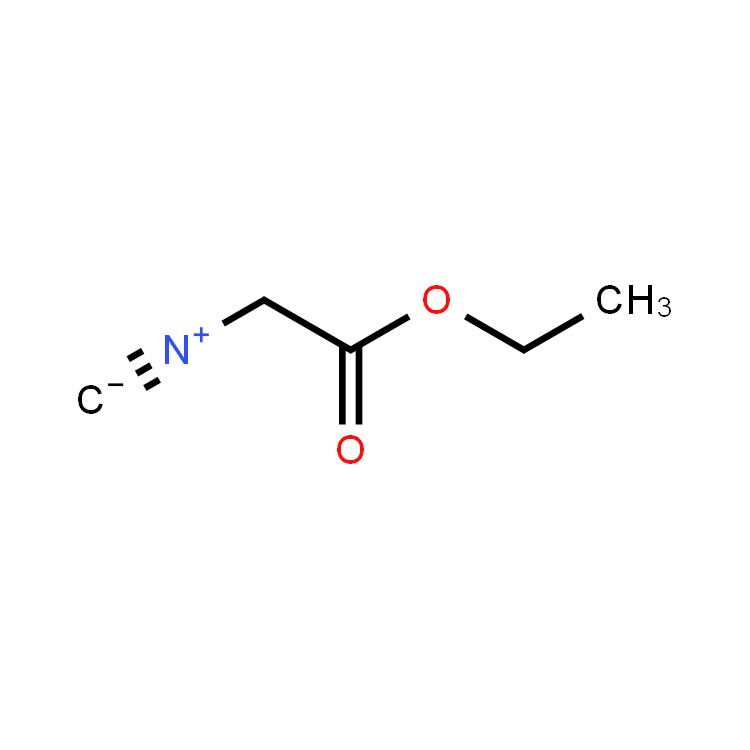
Ethyl isocyanoacetate、2999-46-4
AI Product Description
*The following content is generated by AI and is for reference only.
Ethyl isocyanoacetate, identified by its CAS Registry Number 105-67-3, is a versatile and highly reactive organic intermediate widely utilized in the synthesis of complex heterocyclic compounds. Its molecular formula is C4H5NO2, reflecting a structure that combines an ethyl ester group with a distinctive isocyanide functionality. This unique chemical architecture makes it an indispensable building block in modern medicinal chemistry and agrochemical research. The primary application of ethyl isocyanoacetate lies in its ability to participate in multicomponent reactions, most notably the Passerini reaction and the Ugi four-component condensation. In these processes, it reacts efficiently with aldehydes or ketones and amines to generate diverse alpha-amino acid derivatives and peptide mimics with high atom economy.
Beyond pharmaceutical development, this reagent plays a critical role in the industrial production of various nitrogen-containing heterocycles. It serves as a key precursor for synthesizing pyridines, quinolines, imidazoles, and thiazoles, which are fundamental scaffolds found in numerous bioactive molecules. These heterocyclic structures often exhibit significant biological activities, including antimicrobial, antifungal, anticancer, and anti-inflammatory properties. Consequently, ethyl isocyanoacetate is frequently employed by researchers aiming to discover novel drug candidates or optimize existing therapeutic agents. Additionally, its utility extends to materials science, where it contributes to the creation of functional polymers and specialized ligands for coordination chemistry.
Handling this compound requires standard safety precautions due to its potential toxicity and irritant nature. It should be stored in a cool, dry place away from incompatible oxidizers and strong acids to prevent decomposition. While commercially available in various grades suitable for laboratory and pilot-scale applications, users must consult safety data sheets before use. As a cost-effective and efficient reagent, ethyl isocyanoacetate continues to bridge the gap between simple starting materials and sophisticated molecular architectures, driving innovation across the chemical sciences. Its adaptability ensures its enduring relevance in both academic investigations and large-scale manufacturing processes focused on high-value chemical products.











 (All Rights Reserved)
![8-Oxa-1,3-diazaspiro[4.5]decane-2,4-dione](https://eimg.pharmasources.com/image/product/20250403/60fa7223d5a34f24138486ceea0ffb15jpg)
![6,8-Dioxo-5,7-diazaspiro[3.4]octane-2-carboxylic acid](https://eimg.pharmasources.com/image/product/20250403/02effeb5a7639bc84ff1f3add3c0c64fjpg)
![8,16-Diazadispiro[6.1.6.2]heptadecan-17-one](https://eimg.pharmasources.com/image/product/20250403/ca91cba8b87e53fc879f8d8764873a40jpg)