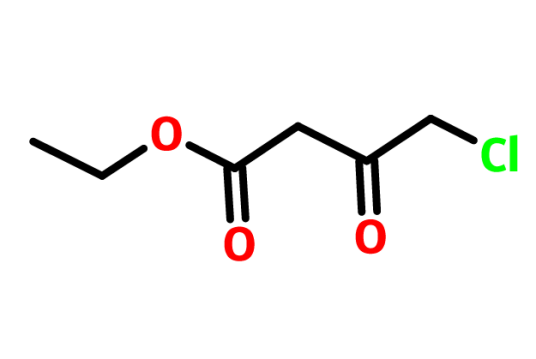
4-Ethyl chloroacetoacetate, chemical formula C6H9ClO3, is often used as an intermediate of medicine and pesticide.
Chemical formula C6H9ClO3 Molecular weight 164.5869CAS registration number 638-07-3EINECS registration number 211-317-0 Flash point 96.67°C Boiling point 235.55°C Density 1.179g/cm³
*The following content is generated by AI and is for reference only.
Ethyl 4-chloroacetoacetate, chemically identified as ethyl 2-chloro-3-oxobutanoate, is a versatile and highly reactive intermediate widely utilized in the pharmaceutical and agrochemical industries. With the molecular formula C6H9ClO3 and a CAS number of 105-57-7, this compound serves as a crucial building block for synthesizing complex heterocyclic structures. Its unique chemical architecture features both an ester group and a chloromethyl ketone moiety, offering dual reactivity that facilitates nucleophilic substitution and condensation reactions essential for advanced organic synthesis.
In the pharmaceutical sector, Ethyl 4-chloroacetoacetate is predominantly employed in the manufacture of pyrazolone derivatives, which are well-known for their analgesic, anti-inflammatory, and antipyretic properties. It acts as a key precursor in the production of non-steroidal anti-inflammatory drugs (NSAIDs) and various cardiovascular agents. Furthermore, its role extends to the synthesis of pyridine and quinoline derivatives, which exhibit significant biological activities including antibacterial, antifungal, and antiviral effects. The presence of the chlorine atom allows for efficient substitution with amines or other nucleophiles, enabling the rapid construction of diverse molecular scaffolds required for drug discovery pipelines.
Beyond medicine, this reagent finds applications in the agrochemical industry, contributing to the development of novel herbicides and pesticides. Its ability to form stable ring systems makes it invaluable for creating compounds that target specific enzymatic pathways in pests while maintaining selectivity for crops. Additionally, researchers utilize it in materials science for developing specialized polymers and functional dyes due to its capacity to participate in Michael addition reactions and cyclization processes.
Handling Ethyl 4-chloroacetoacetate requires standard laboratory safety precautions, as it is moisture-sensitive and can release hydrochloric acid upon decomposition. Proper storage in cool, dry conditions under inert atmosphere ensures stability and maintains its efficacy for synthetic applications. As a fundamental intermediate, it remains indispensable for chemists aiming to innovate in therapeutic and agricultural chemistry, bridging the gap between simple starting materials and high-value active ingredients. Its widespread availability and predictable reactivity profile continue to support global research efforts in medicinal chemistry and industrial manufacturing.





 (All Rights Reserved)
![8-Oxa-1,3-diazaspiro[4.5]decane-2,4-dione](https://eimg.pharmasources.com/image/product/20250403/60fa7223d5a34f24138486ceea0ffb15jpg)
![6,8-Dioxo-5,7-diazaspiro[3.4]octane-2-carboxylic acid](https://eimg.pharmasources.com/image/product/20250403/02effeb5a7639bc84ff1f3add3c0c64fjpg)
![8,16-Diazadispiro[6.1.6.2]heptadecan-17-one](https://eimg.pharmasources.com/image/product/20250403/ca91cba8b87e53fc879f8d8764873a40jpg)
