Product Description
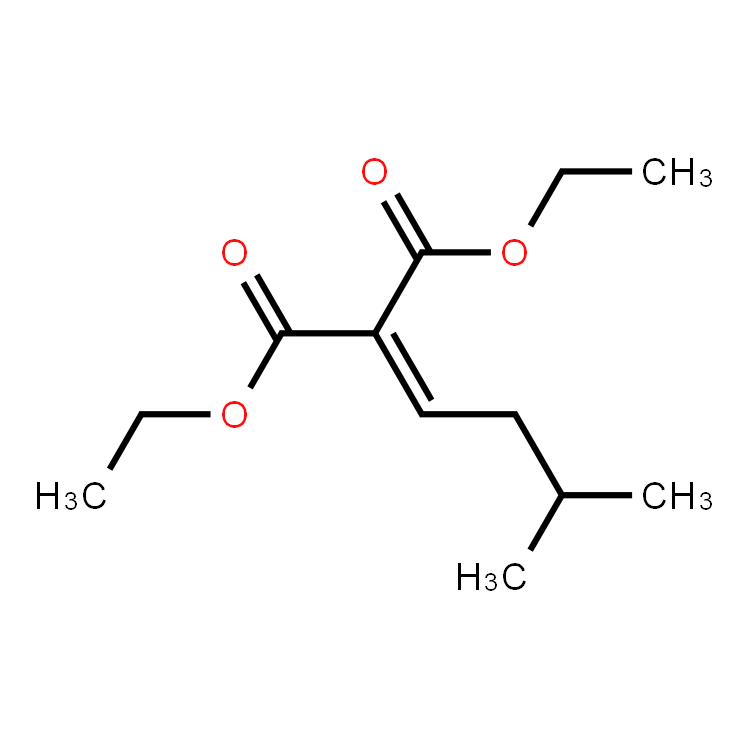
diethyl 2-(3-methylbutylidene)propanedioate、51615-30-6
AI Product Description
*The following content is generated by AI and is for reference only.
Diethyl 2-(3-methylbutylidene)propanedioate is a specialized organic compound belonging to the class of unsaturated diesters. With the molecular formula C12H20O4 and a molecular weight of approximately 228.29 g/mol, this substance features a distinctive carbon-carbon double bond linking a propanedioate moiety to a branched alkyl chain derived from isopentane. While specific commercial CAS registry numbers for this exact stereoisomer may vary depending on precise structural configuration or vendor cataloging, it generally falls under the broader category of activated methylene derivatives used in advanced synthesis. The molecule serves as a versatile intermediate in medicinal chemistry and materials science, particularly valued for its role in Michael addition reactions and heterocyclic synthesis.
In pharmaceutical research, this compound acts as a crucial building block for constructing complex ring systems such as pyridines, quinolines, and various substituted cyclohexenes. Its electron-deficient double bond makes it highly reactive toward nucleophiles, facilitating the rapid assembly of biologically active scaffolds. Researchers frequently employ it in the development of potential anti-inflammatory agents, antitumor drugs, and enzyme inhibitors due to the ease with which functional groups can be introduced onto the ester backbone or the alkylidene side chain. Furthermore, the presence of the ethyl ester groups allows for subsequent hydrolysis or transesterification, offering synthetic flexibility for tailoring physicochemical properties like solubility and lipophilicity.
Beyond drug discovery, applications extend to agrochemicals where similar structures are utilized to create novel pesticides or herbicides targeting specific plant pathways. In polymer chemistry, it may serve as a monomer or modifier to impart unique thermal stability or mechanical strength to specialized resin formulations. Handling requires standard laboratory precautions, including protection from strong oxidizers and moisture, as the ester bonds can undergo hydrolysis under acidic or basic conditions. Overall, Diethyl 2-(3-methylbutylidene)propanedioate represents a valuable tool for chemists seeking efficient routes to complex molecular architectures, bridging the gap between simple precursors and high-value functional materials through robust and predictable reaction kinetics.





 (All Rights Reserved)
![8-Oxa-1,3-diazaspiro[4.5]decane-2,4-dione](https://eimg.pharmasources.com/image/product/20250403/60fa7223d5a34f24138486ceea0ffb15jpg)
![6,8-Dioxo-5,7-diazaspiro[3.4]octane-2-carboxylic acid](https://eimg.pharmasources.com/image/product/20250403/02effeb5a7639bc84ff1f3add3c0c64fjpg)


![8,16-Diazadispiro[6.1.6.2]heptadecan-17-one](https://eimg.pharmasources.com/image/product/20250403/ca91cba8b87e53fc879f8d8764873a40jpg)