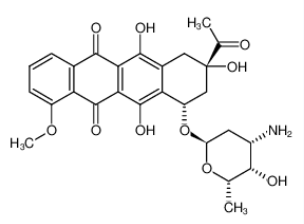
It is a chemotherapeutic agent belonging to the anthracycline antibiotics and is used to treat certain types of cancer,mainly for leukemia treatment. It can slow or stop the growth of cancer cells and is usually used in combination with other chemotherapeutic drugs. Approach of administration depends on the type of tumor.
*The following content is generated by AI and is for reference only.
Daunorubicin is a potent anthracycline antibiotic originally isolated from the bacterium *Streptomyces coeruleorubidus*. It serves as a cornerstone chemotherapy agent, primarily utilized in the treatment of acute myeloid leukemia (AML) and certain types of acute lymphoblastic leukemia (ALL). The drug functions by intercalating between DNA base pairs, thereby inhibiting topoisomerase II activity. This mechanism prevents DNA replication and transcription, ultimately triggering apoptosis in rapidly dividing malignant cells. Its molecular formula is C27H29NO11, and it is uniquely identified by the CAS registry number 23541-50-6. Structurally, daunorubicin shares significant similarities with doxorubicin but possesses a methyl group instead of a hydroxyl group at the C4 position, which influences its pharmacokinetic profile and toxicity spectrum.
Clinically, daunorubicin is almost exclusively administered via intravenous infusion due to its instability and severe tissue irritation if extravasation occurs. It is frequently combined with other cytotoxic agents such as cytarabine or vincristine in induction regimens for newly diagnosed leukemia patients. While highly effective, its therapeutic window is narrow, necessitating careful dose monitoring. The most significant adverse effect associated with daunorubicin is cumulative cardiotoxicity, which can lead to irreversible congestive heart failure. Consequently, lifetime cumulative dosage limits are strictly enforced to mitigate cardiac risks. Other common side effects include severe myelosuppression, resulting in increased susceptibility to infections and bleeding, as well as gastrointestinal disturbances like nausea and vomiting. Additionally, patients may experience alopecia and mucositis during treatment. Despite these challenges, daunorubicin remains a critical component in modern oncology protocols. Research continues into liposomal formulations and novel delivery systems to enhance tumor targeting while reducing systemic toxicity. As a first-line therapy for specific hematologic malignancies, its role in extending patient survival and achieving remission remains indispensable in clinical practice worldwide.



 (All Rights Reserved)


![8-Oxa-1,3-diazaspiro[4.5]decane-2,4-dione](https://eimg.pharmasources.com/image/product/20250403/60fa7223d5a34f24138486ceea0ffb15jpg)
![8,16-Diazadispiro[6.1.6.2]heptadecan-17-one](https://eimg.pharmasources.com/image/product/20250403/ca91cba8b87e53fc879f8d8764873a40jpg)
![6,8-Dioxo-5,7-diazaspiro[3.4]octane-2-carboxylic acid](https://eimg.pharmasources.com/image/product/20250403/02effeb5a7639bc84ff1f3add3c0c64fjpg)