Product Description
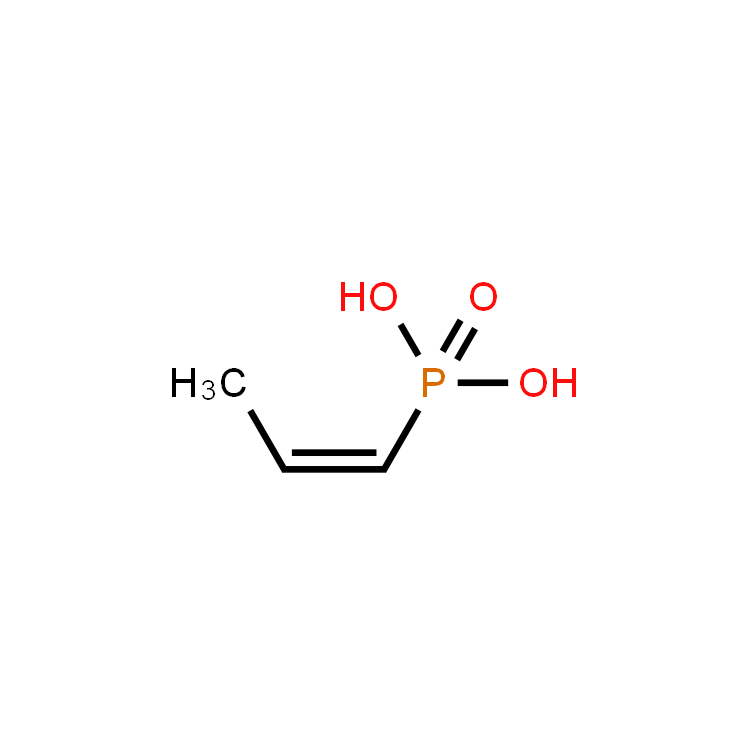
Cis-propenylphosphonic acid、25383-06-6
AI Product Description
*The following content is generated by AI and is for reference only.
Cis-propenylphosphonic acid is a specialized organophosphorus compound characterized by the presence of a phosphonic acid group attached to a cis-configured propenyl chain. Its molecular formula is C3H7O3P, reflecting its composition of three carbon atoms, seven hydrogen atoms, three oxygen atoms, and one phosphorus atom. The specific stereochemistry, defined by the "cis" configuration across the double bond, distinguishes it from its trans-isomer, potentially influencing its reactivity and biological interactions. While a universally unique CAS number for this exact stereoisomer is not always prominently listed in general commercial databases compared to common isomers, it falls under the broader classification of vinylphosphonic acids and related derivatives.
This compound serves as a critical intermediate in advanced chemical synthesis and materials science. One of its primary applications lies in the development of high-performance polymers and resins. Due to the acidic nature of the phosphonic group, it can be utilized as a monomer to create copolymers with enhanced thermal stability and flame retardancy, making it valuable for engineering plastics used in automotive and aerospace industries. Furthermore, researchers explore its potential in water treatment technologies. Organophosphonates are well-known for their ability to chelate metal ions, effectively preventing scale formation in industrial cooling systems and boilers. Cis-propenylphosphonic acid may offer unique solubility or binding characteristics suitable for specific water conditioning formulations.
In the pharmaceutical sector, although less common than other analogs, structurally similar phosphonic acids are investigated for their biological activity, including potential antiviral or enzyme inhibition properties. The precise geometry of the molecule allows for specific interactions within biological targets, which could be exploited in drug design. Additionally, it acts as a precursor for synthesizing more complex ligands used in coordination chemistry and catalysis. As the demand for sustainable and efficient industrial chemicals grows, understanding the specific properties of such stereoisomeric variants becomes increasingly important for optimizing reaction pathways and material performance. Continuous research aims to unlock further applications in green chemistry and specialized functional materials.











 (All Rights Reserved)
![8-Oxa-1,3-diazaspiro[4.5]decane-2,4-dione](https://eimg.pharmasources.com/image/product/20250403/60fa7223d5a34f24138486ceea0ffb15jpg)
![6,8-Dioxo-5,7-diazaspiro[3.4]octane-2-carboxylic acid](https://eimg.pharmasources.com/image/product/20250403/02effeb5a7639bc84ff1f3add3c0c64fjpg)
![8,16-Diazadispiro[6.1.6.2]heptadecan-17-one](https://eimg.pharmasources.com/image/product/20250403/ca91cba8b87e53fc879f8d8764873a40jpg)