Product Description
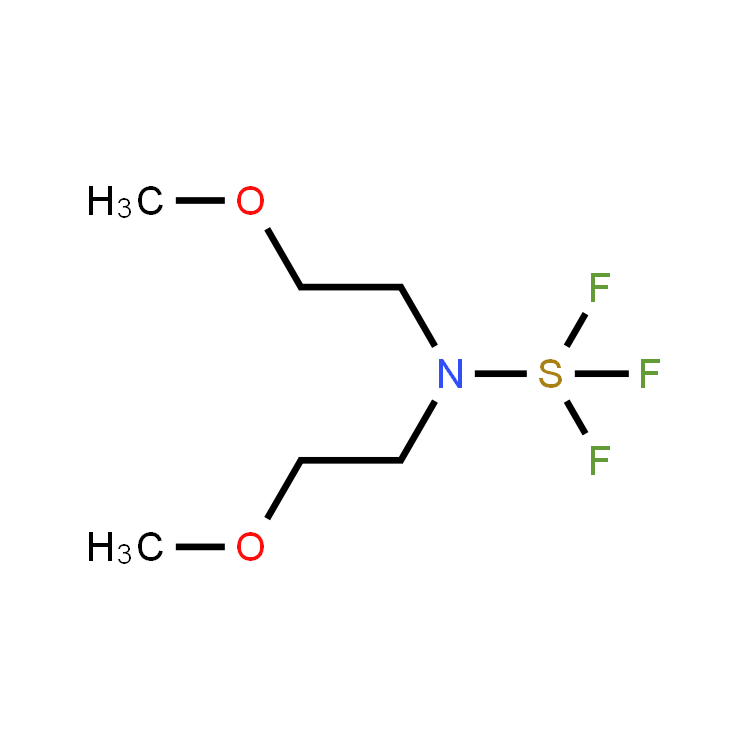
Bis(2-methoxyethyl)aminosulfur trifluoride、202289-38-1
AI Product Description
*The following content is generated by AI and is for reference only.
Bis(2-methoxyethyl)aminosulfur trifluoride, commonly abbreviated as DAST (Diethylaminosulfur trifluoride) analog or specifically referred to by its full chemical name, is a highly specialized and potent fluorinating reagent widely utilized in organic synthesis. Its molecular formula is C6H14F3NO2S, and it is identified by the CAS number 56809-75-3. This compound features a central sulfur atom bonded to three fluorine atoms and an amine group substituted with two 2-methoxyethyl chains, creating a unique electronic environment that facilitates efficient nucleophilic substitution reactions.
The primary application of bis(2-methoxyethyl)aminosulfur trifluoride lies in the conversion of alcohols into alkyl fluorides, a transformation that is often challenging to achieve using traditional methods due to the poor leaving group ability of hydroxyl groups. Unlike many other fluorinating agents, this reagent operates under mild conditions, typically at room temperature or slightly elevated temperatures, making it suitable for sensitive substrates that might decompose under harsher acidic or basic conditions. It effectively transforms primary, secondary, and even some tertiary alcohols into their corresponding fluorides with high stereochemical retention, which is crucial in the synthesis of complex pharmaceutical intermediates and natural products. Furthermore, it is capable of converting carbonyl compounds into gem-difluoro derivatives, expanding its utility beyond simple alcohol activation.
Safety considerations are paramount when handling this substance. It is moisture-sensitive and reacts vigorously with water to release toxic hydrogen fluoride gas, necessitating strict adherence to anhydrous conditions during storage and usage. Consequently, it must be handled in a dry inert atmosphere, such as nitrogen or argon, within a well-ventilated fume hood equipped with appropriate personal protective equipment. Despite its hazards, its efficiency and selectivity make it an indispensable tool in modern medicinal chemistry and fine chemical manufacturing. Researchers frequently employ it to introduce fluorine atoms into drug candidates to modulate metabolic stability, lipophilicity, and binding affinity, thereby enhancing the pharmacological profile of new therapeutic agents. Its role remains critical in advancing the development of novel bioactive molecules where precise fluorination is required.





 (All Rights Reserved)
![8-Oxa-1,3-diazaspiro[4.5]decane-2,4-dione](https://eimg.pharmasources.com/image/product/20250403/60fa7223d5a34f24138486ceea0ffb15jpg)
![6,8-Dioxo-5,7-diazaspiro[3.4]octane-2-carboxylic acid](https://eimg.pharmasources.com/image/product/20250403/02effeb5a7639bc84ff1f3add3c0c64fjpg)
![8,16-Diazadispiro[6.1.6.2]heptadecan-17-one](https://eimg.pharmasources.com/image/product/20250403/ca91cba8b87e53fc879f8d8764873a40jpg)