Product Description
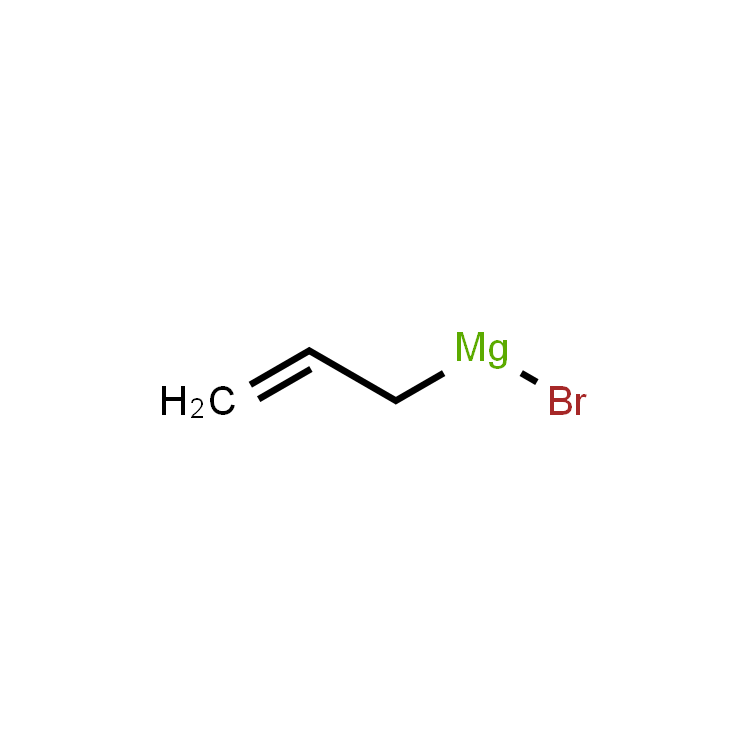
Allylmagnesium bromide、1730-25-2
AI Product Description
*The following content is generated by AI and is for reference only.
Allylmagnesium bromide is a versatile and highly reactive organomagnesium compound widely utilized in organic synthesis as a potent allylating reagent. Classified chemically as an organometallic Grignard reagent, it consists of an allyl group attached to a magnesium atom, which is further coordinated with a bromine atom. Its molecular formula is C3H5MgBr, reflecting the stoichiometric combination of three carbon atoms, five hydrogen atoms, one magnesium atom, and one bromine atom. The substance is commercially identified by the CAS Registry Number 1069-47-8, a unique identifier essential for regulatory compliance and inventory management across chemical supply chains.
Physically, allylmagnesium bromide typically exists as a solution in ether solvents, such as diethyl ether or tetrahydrofuran (THF), due to its extreme sensitivity to moisture and air. Upon exposure to atmospheric conditions, it reacts violently with water to release flammable hydrocarbons and can ignite spontaneously. Consequently, strict handling protocols involving inert atmospheres like nitrogen or argon are mandatory during storage and usage to ensure laboratory safety.
The primary utility of this reagent lies in its ability to transfer the allyl group to various electrophiles, making it indispensable in the construction of complex carbon-carbon bonds. It is extensively employed in the pharmaceutical industry for synthesizing active pharmaceutical ingredients (APIs) containing specific allylic motifs, which are crucial for biological activity. Furthermore, it serves as a key intermediate in the production of agrochemicals, fragrances, and fine chemicals. In academic research, it facilitates the preparation of alcohols when reacted with carbonyl compounds, enabling the efficient synthesis of secondary and tertiary alcohols with precise structural control.
Despite its high reactivity, allylmagnesium bromide offers excellent regioselectivity and yield in many coupling reactions. However, users must exercise caution regarding its thermal instability and potential for exothermic decomposition. Proper disposal procedures are required to neutralize residual reagents before waste removal. Overall, allylmagnesium bromide remains a cornerstone reagent in modern synthetic chemistry, bridging fundamental research and industrial application through its reliable performance in carbon functionalization processes.











 (All Rights Reserved)
![8-Oxa-1,3-diazaspiro[4.5]decane-2,4-dione](https://eimg.pharmasources.com/image/product/20250403/60fa7223d5a34f24138486ceea0ffb15jpg)
![6,8-Dioxo-5,7-diazaspiro[3.4]octane-2-carboxylic acid](https://eimg.pharmasources.com/image/product/20250403/02effeb5a7639bc84ff1f3add3c0c64fjpg)
![8,16-Diazadispiro[6.1.6.2]heptadecan-17-one](https://eimg.pharmasources.com/image/product/20250403/ca91cba8b87e53fc879f8d8764873a40jpg)