We has been focusing on the R&D and production of optoelectronic materials for more than ten years, including OLED materials and perovskite materials .ThIis block can be used in the pharmaceutical and OLED industries
*The following content is generated by AI and is for reference only.
9-Anthraceneboronic acid is a specialized organoboron compound widely utilized in advanced organic synthesis and materials science. With the molecular formula C14H11BO2 and the CAS registry number 68395-36-6, this reagent features an anthracene core substituted with a boronic acid functional group at the central 9-position. This unique structural arrangement imparts distinct photophysical properties, making it highly valuable for developing luminescent materials and fluorescent sensors. The anthracene moiety serves as a robust fluorophore, while the boronic acid group offers versatile reactivity, allowing for easy conjugation with other molecules or incorporation into polymer networks.
In the pharmaceutical industry, 9-anthraceneboronic acid acts as a critical intermediate for synthesizing complex heterocyclic compounds and bioactive agents. Its ability to participate in Suzuki-Miyaura cross-coupling reactions enables chemists to construct carbon-carbon bonds efficiently under mild conditions, facilitating the production of novel drug candidates with improved therapeutic profiles. Furthermore, the compound plays a pivotal role in the development of organic light-emitting diodes (OLEDs) and organic field-effect transistors (OFETs). The rigid planar structure of the anthracene backbone enhances charge transport characteristics, while the boronic functionality aids in fine-tuning energy levels within the device architecture. Researchers frequently employ this molecule to create high-efficiency emitters that exhibit strong blue or green fluorescence, essential for next-generation display technologies.
Additionally, the compound finds applications in supramolecular chemistry and metal-organic frameworks (MOFs). The boronic acid group can form reversible covalent bonds with diols, enabling the construction of dynamic self-assembled systems responsive to environmental stimuli such as pH or specific analytes. This sensitivity makes 9-anthraceneboronic acid suitable for designing smart sensing platforms capable of detecting sugars, toxins, or biological markers with high selectivity. Despite its utility, handling requires standard safety precautions due to potential skin irritation and environmental hazards associated with organoboron substances. Overall, 9-anthraceneboronic acid represents a cornerstone reagent bridging fundamental research and industrial innovation across electronics, medicine, and nanotechnology sectors.

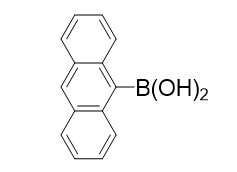




 (All Rights Reserved)
![(6-phenyldibenzo[b,d]thiophen-4-yl)boronic acid](https://eimg.pharmasources.com/image/20250918/VzkRtcz9igDw870AqZ3zYo3SOO3IOeqwh9VdEbLS.png)

![[1,1':4',1''-Terphenyl]-2,6-diol, 2'-fluoro-](https://eimg.pharmasources.com/image/20240314/BTJGUNOZ2gmyX3HLfV4HO89Qpi7WQfGsPD1Qh3Az.jpeg)
![3-Iodo-5-tert-butylbenzo[b]thiophene](https://eimg.pharmasources.com/image/product/20250919/370cd976e4b82e45e310eab5fdf6b1f1jpg)


![5-Hydroxy-3,9-dimethyl-7H-benzo[c]fluoren-7-one](https://eimg.pharmasources.com/image/product/20250919/d01931f02fb1e7e8231c9933d73e3837jpg)
![Ethyl 5-methylbenzo[b]thiophene-2-carboxylate](https://eimg.pharmasources.com/image/product/20250919/bd4b4317408ace91b597157b395c106bjpg)
![3-Bromo-5-tert-butylbenzo[b]thiophene](https://eimg.pharmasources.com/image/product/20250919/742a9f6c2521018bdd155a4ef08a8873jpg)