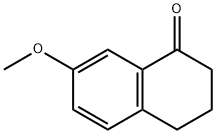
Product name: 7-Methoxy-1-tetralone
Synonymous: 7-Methoxy-1,2,3,4-tetrahydronaphthalene-1-one;7-Methoxy-1-oxotetraline;7-Methoxy-1-tetralinone;7-Methoxy-1-tetralone,97%;7-M;7-methoxytetralin-1-one;3,4-Dihydro-7-methoxy-1(2H)-naphthalenone;7-Methoxy-1-tetralon
CAS No.: 6836-19-7
Molecular formula: C11H12O2
Molecular weight: 176.21
EINECS No.: 229-916-0
Application: Agomelatine’s intermediate
*The following content is generated by AI and is for reference only.
7-Methoxy-1-tetralone is a specialized organic compound belonging to the tetralone family, widely recognized in medicinal chemistry and pharmaceutical research for its versatile synthetic utility. With the molecular formula C11H12O2 and a molecular weight of approximately 176.21 g/mol, this pale yellow crystalline solid serves as a crucial building block for constructing complex heterocyclic systems. Its Chemical Abstracts Service (CAS) Registry Number is 4085-93-4, which facilitates precise identification in chemical databases and inventory management systems globally.
The primary application of 7-methoxy-1-tetralone lies in its role as a key intermediate in the synthesis of bioactive molecules, particularly those with potential pharmacological properties. It is frequently employed as a precursor in the preparation of substituted chromans, benzodiazepines, and various alkaloids that exhibit antihypertensive, anxiolytic, or anti-inflammatory activities. The presence of the methoxy group at the seventh position enhances its reactivity profile, allowing chemists to perform electrophilic substitutions or reduction reactions with high regioselectivity. This structural feature makes it indispensable for developing novel drug candidates targeting specific biological receptors.
Beyond pharmaceutical development, this compound finds niche applications in agrochemical research, where it contributes to the creation of new pesticides and herbicides designed to improve crop yield and resistance. In academic settings, 7-methoxy-1-tetralone is often utilized in mechanistic studies involving carbonyl chemistry and aromatic substitution patterns. Researchers appreciate its stability under standard laboratory conditions, which simplifies handling and storage procedures. Furthermore, its solubility characteristics allow for easy integration into various organic solvents, facilitating diverse reaction pathways. As the demand for innovative therapeutic agents grows, the importance of efficient synthetic routes utilizing such intermediaries becomes increasingly significant. Supply chains for 7-methoxy-1-tetralone are maintained by major chemical suppliers, ensuring availability for both small-scale exploratory research and larger industrial manufacturing processes. Its continued relevance underscores the dynamic nature of organic synthesis in advancing modern science and technology.





 (All Rights Reserved)
![Pyrrolo[2,3-d]pyrimidin-4-ol](https://eimg.pharmasources.com/image/20250423/cvXgKDastRYgD63GYBroAOcjpuRzGHJvGxhaKgvA.gif)
![4-Chloro-7H-pyrrolo[2,3-d]pyrimidine](https://eimg.pharmasources.com/image/20250423/Vo6dULaYnbLZCd7lJ7013faOnpM4iolBbJyR708d.gif)
![1,6-dihydro-5-hydroxy-1-methyl-2-[1-methyl-1-[[(phenylmethoxy)carbonyl]amino]ethyl]-6-oxo-4-Pyrimidi](https://eimg.pharmasources.com/image/20240312/35lb1ifZuXM3CbTyv7zwyPrhcXy4bmyDTBeUKkDN.gif)
![6,8-Dioxo-5,7-diazaspiro[3.4]octane-2-carboxylic acid](https://eimg.pharmasources.com/image/product/20250403/02effeb5a7639bc84ff1f3add3c0c64fjpg)
![8-Oxa-1,3-diazaspiro[4.5]decane-2,4-dione](https://eimg.pharmasources.com/image/product/20250403/60fa7223d5a34f24138486ceea0ffb15jpg)
![8,16-Diazadispiro[6.1.6.2]heptadecan-17-one](https://eimg.pharmasources.com/image/product/20250403/ca91cba8b87e53fc879f8d8764873a40jpg)