Product Description
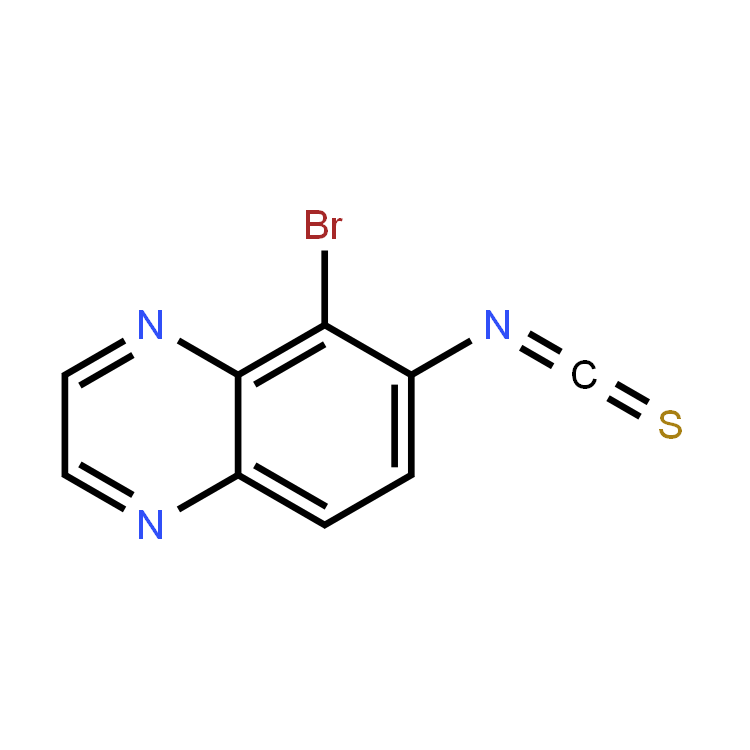
5-Bromo-6-isothiocyanato-quinoxaline、134892-46-9
AI Product Description
*The following content is generated by AI and is for reference only.
5-Bromo-6-isothiocyanatoquinoxaline is a specialized heterocyclic compound widely utilized in chemical synthesis and pharmaceutical research. With the molecular formula C8H4BrN3S, this molecule features a quinoxaline core substituted with a bromine atom at the 5-position and an isothiocyanate group at the 6-position. Its Chemical Abstracts Service (CAS) registry number is 123790-48-9, serving as a unique identifier for inventory management and safety data tracking. The presence of the highly reactive isothiocyanate functional group makes this reagent particularly valuable for bioconjugation applications. It readily reacts with primary amines and thiols to form stable thiourea and thiazolidinone derivatives, respectively, which is a critical mechanism in labeling biomolecules such as proteins, antibodies, and nucleic acids for detection assays.
In medicinal chemistry, this compound serves as a versatile scaffold for constructing complex heterocyclic libraries. Researchers employ it as a building block to synthesize novel kinase inhibitors, anticancer agents, and antimicrobial drugs. The bromine substituent offers a strategic handle for further cross-coupling reactions, such as Suzuki or Buchwald-Hartwig couplings, allowing chemists to introduce diverse aromatic systems and modulate the biological activity of the resulting compounds. Consequently, 5-Bromo-6-isothiocyanatoquinoxaline is frequently found in the workflows of academic laboratories and industrial R&D departments focused on drug discovery.
The compound typically appears as a yellow to orange crystalline solid. Due to the potential irritancy of isothiocyanates, handling requires appropriate personal protective equipment, including gloves and eye protection, within a well-ventilated fume hood. Storage should be conducted in a cool, dry place away from moisture and strong bases to prevent premature hydrolysis of the isothiocyanate moiety. While specific toxicity profiles vary by study, standard precautionary measures for halogenated organic solvents and nitrogen-containing heterocycles are recommended. Overall, this reagent represents a powerful tool for advancing chemical biology and therapeutic development through its dual functionality as both a coupling agent and a structural precursor.











 (All Rights Reserved)
![8-Oxa-1,3-diazaspiro[4.5]decane-2,4-dione](https://eimg.pharmasources.com/image/product/20250403/60fa7223d5a34f24138486ceea0ffb15jpg)
![6,8-Dioxo-5,7-diazaspiro[3.4]octane-2-carboxylic acid](https://eimg.pharmasources.com/image/product/20250403/02effeb5a7639bc84ff1f3add3c0c64fjpg)
![8,16-Diazadispiro[6.1.6.2]heptadecan-17-one](https://eimg.pharmasources.com/image/product/20250403/ca91cba8b87e53fc879f8d8764873a40jpg)