Product Description
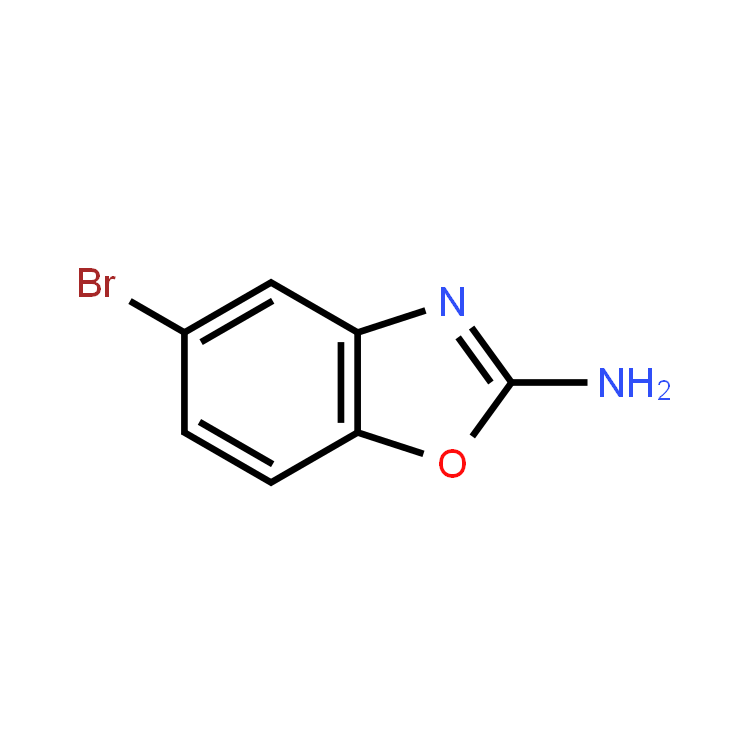
5-Bromo-1,3-benzoxazol-2-amine、64037-07-6
AI Product Description
*The following content is generated by AI and is for reference only.
5-Bromo-1,3-benzoxazol-2-amine is a specialized heterocyclic compound widely recognized in medicinal chemistry and materials science for its versatile synthetic utility. With the molecular formula C7H5BrN2O and a CAS number of 84669-50-1, this molecule features a fused benzene ring linked to an oxazole moiety, substituted with both a bromine atom at the fifth position and an amino group at the second position. This unique structural configuration endows it with significant reactivity, making it an invaluable building block for the construction of complex pharmaceutical agents and functional organic materials.
The primary application of 5-Bromo-1,3-benzoxazol-2-amine lies in its role as a key intermediate in the synthesis of biologically active compounds. Researchers frequently utilize it as a precursor for developing novel kinase inhibitors, anti-inflammatory drugs, and antimicrobial agents. The presence of the bromine substituent allows for efficient palladium-catalyzed cross-coupling reactions, such as Suzuki-Miyaura or Buchwald-Hartwig couplings, enabling the rapid attachment of various aryl or alkyl groups to generate diverse chemical libraries. Furthermore, the amino group serves as a nucleophilic site for further derivatization, facilitating the creation of dyes, fluorescent probes, and ligands for coordination chemistry.
In the realm of materials science, derivatives of this compound are explored for their potential use in organic light-emitting diodes (OLEDs) and photovoltaic devices due to their favorable electronic properties and stability. The rigid planar structure of the benzoxazole core contributes to excellent thermal stability and charge transport characteristics, which are crucial for high-performance electronic applications. Additionally, its solubility profile can be easily modified through substitution, allowing for tailored processing in different solvent systems.
Safety handling requires standard precautions typical for halogenated aromatic amines, including the avoidance of skin contact and inhalation, as some derivatives may exhibit toxicity. Overall, 5-Bromo-1,3-benzoxazol-2-amine remains a cornerstone reagent in modern organic synthesis, bridging the gap between fundamental research and industrial application in drug discovery and advanced material development. Its continued study promises new breakthroughs in therapeutic interventions and technological innovations.





 (All Rights Reserved)
![8-Oxa-1,3-diazaspiro[4.5]decane-2,4-dione](https://eimg.pharmasources.com/image/product/20250403/60fa7223d5a34f24138486ceea0ffb15jpg)
![6,8-Dioxo-5,7-diazaspiro[3.4]octane-2-carboxylic acid](https://eimg.pharmasources.com/image/product/20250403/02effeb5a7639bc84ff1f3add3c0c64fjpg)

![8,16-Diazadispiro[6.1.6.2]heptadecan-17-one](https://eimg.pharmasources.com/image/product/20250403/ca91cba8b87e53fc879f8d8764873a40jpg)