*The following content is generated by AI and is for reference only.
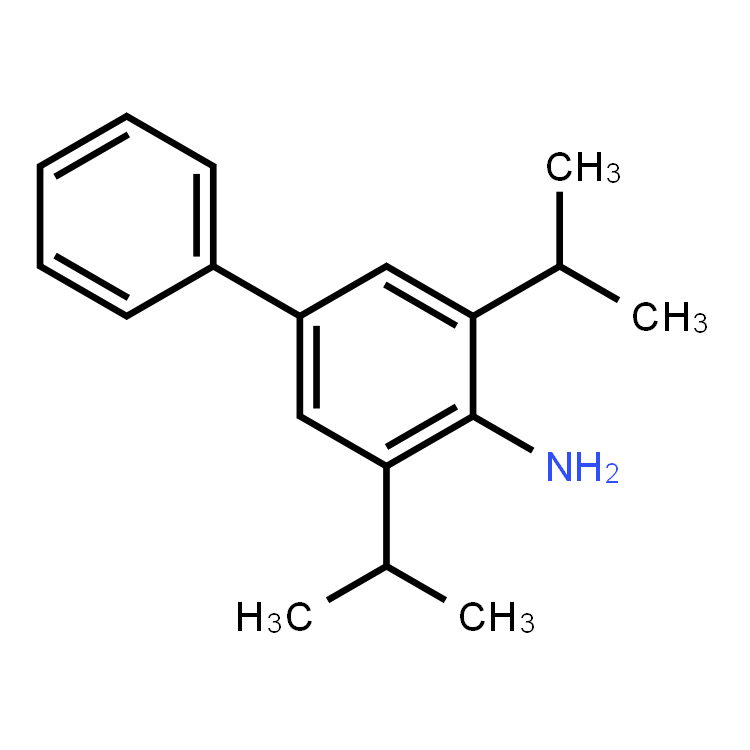
4-Phenyl-2,6-di(propan-2-yl)aniline is a specialized organic compound characterized by an aniline core substituted with two bulky isopropyl groups at the ortho positions and a phenyl ring attached to the para position. Its molecular formula is C17H21N, reflecting a high degree of hydrophobicity and steric hindrance due to the geminal dimethyl arrangements on the aromatic rings. The Compound does not possess a widely recognized CAS registry number in major public databases under this exact systematic name, suggesting it may be a specific intermediate synthesized for research purposes or known under alternative nomenclature such as 4-phenyl-2,6-diisopropylaniline.
This molecule serves primarily as a sophisticated building block in medicinal chemistry and materials science. The strategic placement of the two isopropyl groups creates significant steric bulk around the amino nitrogen, which can modulate the electronic properties and reactivity of the amine group. This feature makes it highly valuable for synthesizing complex heterocyclic systems, particularly when designing ligands for transition metal catalysts where steric protection is crucial for stabilizing reactive intermediates. Furthermore, the extended conjugation provided by the phenyl substituent allows for potential applications in the development of fluorescent probes or organic semiconductors. In pharmaceutical research, derivatives of this scaffold are investigated for their potential biological activities, including enzyme inhibition, where the lipophilic nature aids in membrane permeability. Due to its specific structural complexity, it is often utilized in academic laboratories for mechanistic studies regarding nucleophilic substitution reactions or oxidative coupling processes. While not a commodity chemical available in large-scale industrial quantities, it represents a critical tool for fine-tuning molecular architectures in advanced synthesis projects. Researchers utilize this compound to explore structure-activity relationships (SAR) and to develop novel functional materials with tailored electronic characteristics.