Product Description
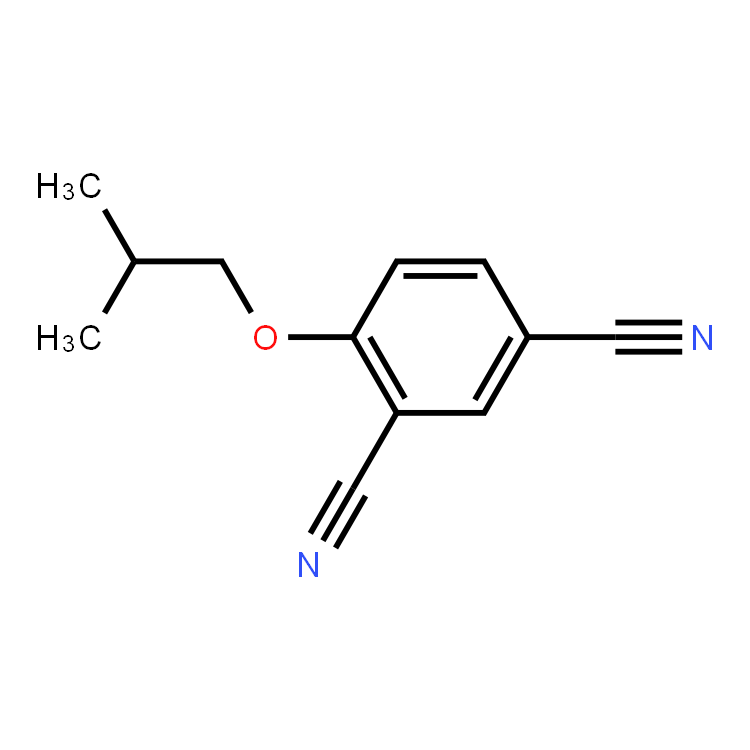
4-Isobutyloxy-1,3-benzenedicarbonitrile、161718-81-6
AI Product Description
*The following content is generated by AI and is for reference only.
4-Isobutyloxy-1,3-benzenedicarbonitrile is a specialized organic intermediate primarily utilized in the fields of pharmaceutical research and agrochemical synthesis. With the molecular formula C₁₂H₁₂N₂O and a molecular weight of approximately 204.24 g/mol, this compound features a benzene ring substituted with two cyano groups at the 1 and 3 positions, alongside an isobutyloxy ether group at the 4-position. This unique structural arrangement endows the molecule with distinct chemical reactivity, making it a valuable building block for constructing complex heterocyclic systems and bioactive scaffolds.
The primary application of 4-isobutyloxy-1,3-benzenedicarbonitrile lies in its role as a precursor for the synthesis of advanced pharmaceutical agents. Researchers often employ this substrate to develop novel kinase inhibitors, anti-inflammatory drugs, or compounds targeting specific neurological pathways. The presence of the nitrile functionalities allows for versatile downstream transformations, including hydrolysis to carboxylic acids, reduction to amines, or cyclization reactions to form pyridine and quinoline derivatives. Similarly, in the agricultural sector, this chemical serves as a key intermediate for producing modern herbicides and fungicides designed to enhance crop yield while minimizing environmental impact. The isobutyloxy moiety contributes to optimizing the lipophilicity and metabolic stability of final active ingredients, which are critical factors in drug efficacy and formulation performance.
From a safety perspective, handling this substance requires standard laboratory precautions due to potential toxicity associated with nitrile compounds. It should be stored in a cool, dry place away from strong oxidizing agents and moisture to prevent decomposition or hydrolysis. While not widely available as a bulk commodity like common solvents, it is accessible through specialized chemical suppliers catering to the fine chemical and R&D industries. Its synthesis typically involves the nucleophilic substitution of a suitable phenolic precursor with isobutyl halides followed by selective cyanation. As the demand for precision medicine and sustainable agriculture grows, intermediates like 4-isobutyloxy-1,3-benzenedicarbonitrile remain essential tools for chemists aiming to innovate new therapeutic solutions and protective crop chemicals efficiently.











 (All Rights Reserved)
![8-Oxa-1,3-diazaspiro[4.5]decane-2,4-dione](https://eimg.pharmasources.com/image/product/20250403/60fa7223d5a34f24138486ceea0ffb15jpg)
![6,8-Dioxo-5,7-diazaspiro[3.4]octane-2-carboxylic acid](https://eimg.pharmasources.com/image/product/20250403/02effeb5a7639bc84ff1f3add3c0c64fjpg)
![8,16-Diazadispiro[6.1.6.2]heptadecan-17-one](https://eimg.pharmasources.com/image/product/20250403/ca91cba8b87e53fc879f8d8764873a40jpg)