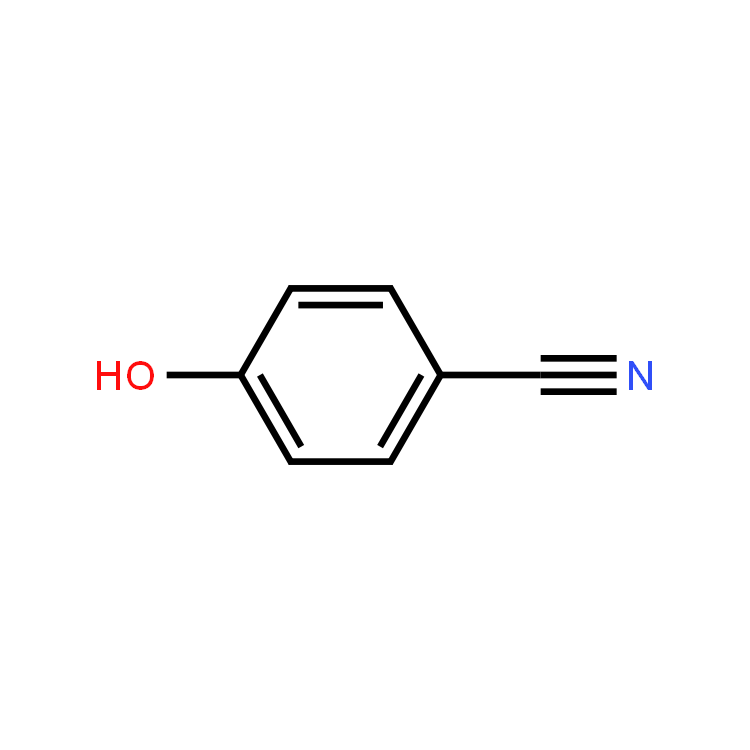
Product Description
4-Hydroxybenzonitrile、767-00-0
AI Product Description
*The following content is generated by AI and is for reference only.
4-Hydroxybenzonitrile, also known as p-hydroxybenzonitrile, is a vital aromatic organic compound widely utilized in pharmaceutical synthesis, agrochemical production, and materials science. With the molecular formula C₇H₅NO₂ and a molecular weight of approximately 135.12 g/mol, this white to off-white crystalline solid features a benzene ring substituted with both a hydroxyl group and a nitrile group at para positions. Its standard CAS Registry Number is 99-06-7, ensuring precise identification across global chemical databases and supply chains. The compound exhibits moderate solubility in polar organic solvents like ethanol and dimethyl sulfoxide, while remaining largely insoluble in water, facilitating its use in various reaction media without requiring extensive purification steps prior to downstream processing.
In the pharmaceutical industry, 4-hydroxybenzonitrile serves as a key intermediate for synthesizing active pharmaceutical ingredients (APIs), particularly those containing benzonitrile scaffolds which are essential for developing anti-inflammatory agents, antibiotics, and cardiovascular drugs. Its unique functional groups allow for versatile derivatization, enabling chemists to introduce diverse substituents through nucleophilic substitution or reduction reactions. In agriculture, it plays a crucial role in the manufacturing of herbicides and fungicides, contributing to crop protection strategies by disrupting specific metabolic pathways in pests. Furthermore, researchers utilize this molecule in polymer chemistry to develop high-performance thermoplastics and liquid crystals, leveraging its rigid structure and hydrogen-bonding capabilities to enhance material stability and thermal resistance.
Safety protocols dictate that while generally stable under normal conditions, 4-hydroxybenzonitrile should be handled with care to avoid inhalation of dust or skin contact, as it may cause irritation. Proper storage in cool, dry environments away from strong oxidizers is recommended to maintain purity and prevent degradation. As demand grows for efficient synthetic routes in green chemistry, this compound remains a cornerstone reagent due to its cost-effectiveness and high reactivity profile. Continuous advancements in catalytic methods further expand its application potential, making it an indispensable building block for modern chemical innovation across multiple sectors.











 (All Rights Reserved)
![8-Oxa-1,3-diazaspiro[4.5]decane-2,4-dione](https://eimg.pharmasources.com/image/product/20250403/60fa7223d5a34f24138486ceea0ffb15jpg)
![6,8-Dioxo-5,7-diazaspiro[3.4]octane-2-carboxylic acid](https://eimg.pharmasources.com/image/product/20250403/02effeb5a7639bc84ff1f3add3c0c64fjpg)
![8,16-Diazadispiro[6.1.6.2]heptadecan-17-one](https://eimg.pharmasources.com/image/product/20250403/ca91cba8b87e53fc879f8d8764873a40jpg)