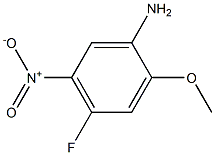
Product name: 4-fluoro-2-Methoxy-5-nitroaniline
Synonymous: 4-fluoro-2-Methoxy-5-nitroaniline; 2-Amino-5-fluoro-4-nitroanisole,4-Fluoro-5-nitro-o-anisidine; 4-Fluoro-2-Methoxy-5-nitrobenzenaMine;4-Fluoro-2-methoxy-5-nitroaniline95+%;Benzenamine,4-fluoro-2-methoxy-5-nitro-;4-fluoro-2-methoxy-5-nitrophenylamine
CAS No.: 1075705-01-9
Molecular formula: C7H7FN2O3
Molecular weight: 186.1404832
EINECS No.: 806-172-0
Application: Osimertinib(AZD9291)’s intermediate
*The following content is generated by AI and is for reference only.
4-Fluoro-2-methoxy-5-nitroaniline is a specialized organic intermediate widely utilized in the fields of pharmaceutical research, agrochemical synthesis, and materials science. With the Chemical Abstracts Service (CAS) registry number 100379-68-4, this compound features a distinct chemical structure characterized by an aniline core substituted with a fluoro group at the fourth position, a methoxy group at the second position, and a nitro group at the fifth position. Its molecular formula is C7H7FN2O3, corresponding to a precise molecular weight of approximately 186.14 g/mol. The presence of these diverse functional groups renders the molecule highly versatile for further chemical transformations, particularly in nucleophilic aromatic substitution reactions where the fluorine atom serves as an excellent leaving group.
In the pharmaceutical industry, this substance serves as a critical building block for synthesizing complex heterocyclic compounds and bioactive molecules. It is frequently employed in the development of novel kinase inhibitors, anti-inflammatory agents, and other therapeutic candidates targeting specific disease pathways. The nitro group can be readily reduced to an amino group, allowing for the construction of diamine derivatives essential for drug scaffolds. Similarly, in agricultural chemistry, it acts as a precursor for designing new herbicides and fungicides, contributing to crop protection strategies. The electron-withdrawing nature of the nitro and fluoro substituents significantly influences the reactivity of the aromatic ring, facilitating regioselective coupling reactions that are vital for high-yield manufacturing processes.
From a safety perspective, while it is a stable solid under standard conditions, proper handling protocols must be observed due to its potential toxicity and environmental impact associated with nitro-aromatic compounds. Storage should occur in a cool, dry, well-ventilated area away from incompatible oxidizers or strong reducing agents. As demand grows for advanced synthetic intermediates in global supply chains, 4-fluoro-2-methoxy-5-nitroaniline remains a valuable commodity for chemists seeking efficient routes to functionalized aromatic systems. Its unique structural profile ensures continued relevance in R&D laboratories aiming to innovate across multiple scientific disciplines.





 (All Rights Reserved)
![Pyrrolo[2,3-d]pyrimidin-4-ol](https://eimg.pharmasources.com/image/20250423/cvXgKDastRYgD63GYBroAOcjpuRzGHJvGxhaKgvA.gif)
![4-Chloro-7H-pyrrolo[2,3-d]pyrimidine](https://eimg.pharmasources.com/image/20250423/Vo6dULaYnbLZCd7lJ7013faOnpM4iolBbJyR708d.gif)
![1,6-dihydro-5-hydroxy-1-methyl-2-[1-methyl-1-[[(phenylmethoxy)carbonyl]amino]ethyl]-6-oxo-4-Pyrimidi](https://eimg.pharmasources.com/image/20240312/35lb1ifZuXM3CbTyv7zwyPrhcXy4bmyDTBeUKkDN.gif)

![Diethyl-2-acetamido-2-(7-chloro-5-(2-fluorophenyl)-3H- benzo[e][1,4]diazepin-2-yl)malonate](https://eimg.pharmasources.com/image/20240603/kCK1tVKXvO7mdpLTBNii5x61NUulXBiqHBf6clcn.png)