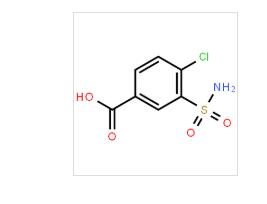
Chinese name 4-chloro-3-sulfamoyl benzoic acid English name 4-Chloro-3-Sulfamoyl Benzoic Acid Chinese alias 4-chloro-3-sulfonamidobenzoic acid; 3-sulfamoyl-4-chlorobenzoic acid; 3-sulfonamido-4-chlorobenzoic acid CAS RN 1205-30-7 EINECS No. 214-882-1 Molecular formula C7H5ClNO4S Molecular weight 234.6374 Uses for pharmaceutical synthesis
*The following content is generated by AI and is for reference only.
4-Chloro-3-sulfamoyl benzoic acid is a specialized organic intermediate widely utilized in the pharmaceutical and agrochemical industries for the synthesis of complex heterocyclic compounds. With the Chemical Abstracts Service (CAS) registry number 25690-78-6, this compound features a benzene ring substituted with a chlorine atom at the fourth position and a sulfamoyl group at the third position, alongside a carboxylic acid functional group. Its molecular formula is C7H6ClNO4S, corresponding to a molar mass of approximately 235.64 g/mol. The presence of both electron-withdrawing halogen and sulfonamide functionalities makes it highly reactive toward nucleophilic substitution and coupling reactions, serving as a critical building block in medicinal chemistry.
In the pharmaceutical sector, this molecule is frequently employed as a precursor for synthesizing sulfa drugs and non-steroidal anti-inflammatory agents. The structural motif closely resembles known pharmacophores found in diuretics and antidiabetic medications, where the sulfamoyl group plays a pivotal role in biological activity by interacting with carbonic anhydrase or other enzymatic targets. Furthermore, its versatility allows researchers to modify the carboxylic acid moiety into esters, amides, or acid chlorides, thereby tailoring the physicochemical properties of final drug candidates for optimal bioavailability and metabolic stability.
Beyond medicine, 4-chloro-3-sulfamoyl benzoic acid finds applications in the development of novel agrochemicals, particularly in the creation of herbicides and fungicides that target specific plant enzymes. The chlorine substituent often enhances lipophilicity, facilitating better penetration through biological membranes in crop protection products. Due to its specific reactivity profile, it is also explored in materials science for the production of functional polymers and dyes requiring precise chemical modification. While handling requires standard safety precautions due to potential irritant properties, its high purity grades are readily available from major chemical suppliers, supporting diverse research and industrial manufacturing needs globally. As a key scaffold in modern organic synthesis, it continues to enable the discovery of next-generation therapeutic and agricultural solutions.





 (All Rights Reserved)
![Pyrrolo[2,3-d]pyrimidin-4-ol](https://eimg.pharmasources.com/image/20250423/cvXgKDastRYgD63GYBroAOcjpuRzGHJvGxhaKgvA.gif)
![4-Chloro-7H-pyrrolo[2,3-d]pyrimidine](https://eimg.pharmasources.com/image/20250423/Vo6dULaYnbLZCd7lJ7013faOnpM4iolBbJyR708d.gif)
![1,6-dihydro-5-hydroxy-1-methyl-2-[1-methyl-1-[[(phenylmethoxy)carbonyl]amino]ethyl]-6-oxo-4-Pyrimidi](https://eimg.pharmasources.com/image/20240312/35lb1ifZuXM3CbTyv7zwyPrhcXy4bmyDTBeUKkDN.gif)