Product Description
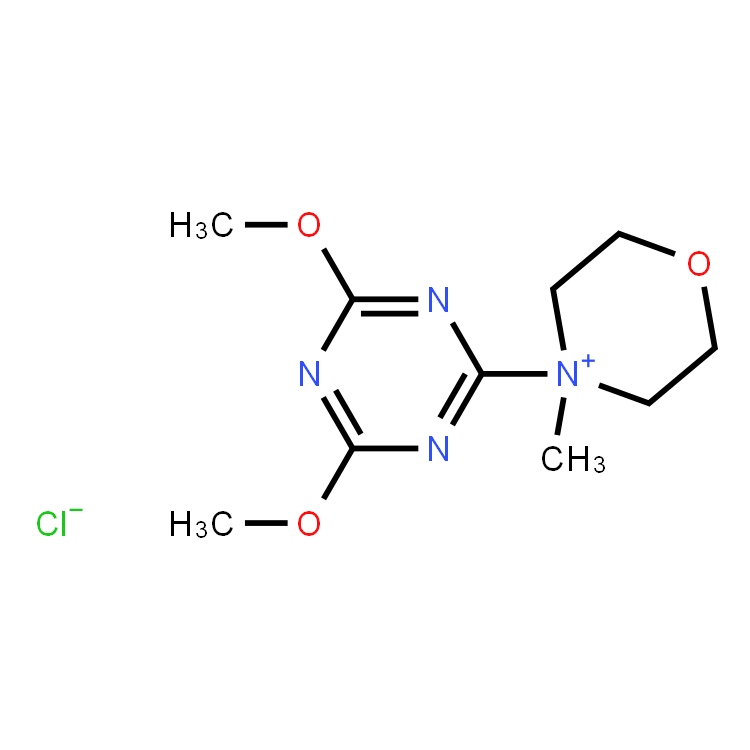
4-(4,6-Dimethoxy-1,3,5-triazin-2-yl)-4-methyl morpholinium chloride、3945-69-5
AI Product Description
*The following content is generated by AI and is for reference only.
4-(4,6-Dimethoxy-1,3,5-triazin-2-yl)-4-methylmorpholinium chloride is a specialized organic reagent widely recognized in synthetic chemistry for its exceptional utility as a coupling agent and activating group. With the molecular formula C9H15ClN4O3 and the CAS number 87108-23-8, this compound serves as a crucial intermediate in the efficient synthesis of amides, esters, and other carbonyl derivatives under mild conditions. Its structural composition features a reactive triazine ring substituted with two methoxy groups and a morpholinium moiety, which collectively enhance its electrophilicity and solubility profile in common organic solvents.
The primary application of this reagent lies in peptide synthesis and bioconjugation protocols, where it facilitates the activation of carboxylic acids without requiring harsh acidic or basic environments that might degrade sensitive functional groups. By converting carboxylic acids into highly reactive O-acylisourea or similar intermediates, it promotes rapid nucleophilic attack by amines to form stable amide bonds with high yields and minimal racemization. This makes it particularly valuable in pharmaceutical research for constructing complex peptidomimetics and drug candidates. Furthermore, its stability and ease of handling allow for straightforward integration into automated solid-phase synthesis workflows.
In addition to peptide chemistry, this compound finds use in polymer science for modifying macromolecules and in material science for creating functionalized surfaces. The presence of the methylated morpholine cation ensures good solubility in polar aprotic solvents like dichloromethane or DMF, enabling homogeneous reaction conditions. Researchers appreciate its ability to operate at room temperature, reducing energy consumption and simplifying purification processes compared to traditional coupling methods involving carbodiimides. As a versatile tool, 4-(4,6-dimethoxy-1,3,5-triazin-2-yl)-4-methylmorpholinium chloride continues to support advancements in medicinal chemistry, offering a reliable pathway for building diverse molecular architectures with precision and efficiency. Its commercial availability underscores its importance as a standard reagent in modern laboratory settings dedicated to organic synthesis and drug discovery.











 (All Rights Reserved)
![8-Oxa-1,3-diazaspiro[4.5]decane-2,4-dione](https://eimg.pharmasources.com/image/product/20250403/60fa7223d5a34f24138486ceea0ffb15jpg)
![6,8-Dioxo-5,7-diazaspiro[3.4]octane-2-carboxylic acid](https://eimg.pharmasources.com/image/product/20250403/02effeb5a7639bc84ff1f3add3c0c64fjpg)
![8,16-Diazadispiro[6.1.6.2]heptadecan-17-one](https://eimg.pharmasources.com/image/product/20250403/ca91cba8b87e53fc879f8d8764873a40jpg)