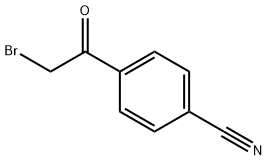
4-(2-Bromoacetyl)benzonitrile is useful for the irreversible inhibitory activity of Glycogen synthase kinase 3 (GSK-3). Phenylhalomethylketones can be used in the study of novel GSK-3 inhibitors.
More information please send email to: pharmchem4@ichemie.com
*The following content is generated by AI and is for reference only.
4-(2-Bromoacetyl)benzonitrile is a specialized organic intermediate widely utilized in the pharmaceutical and agrochemical industries for the synthesis of complex heterocyclic compounds. Its molecular formula is C9H6BrNO, and it is identified by the CAS number 3850-15-7. Structurally, this molecule features a benzonitrile core substituted at the para position with a bromoacetyl group, creating a versatile scaffold that combines the reactivity of an alkyl halide with the electronic properties of a nitrile functionality.
The primary application of 4-(2-Bromoacetyl)benzonitrile lies in its role as a building block for constructing nitrogen-containing heterocycles, particularly quinolines, isoquinolines, and various pyridine derivatives. The electrophilic nature of the bromomethyl group allows for efficient nucleophilic substitution reactions with amines, thiols, or other nucleophiles, facilitating the formation of carbon-nitrogen or carbon-sulfur bonds. Furthermore, the adjacent carbonyl group enhances the acidity of the alpha-protons, enabling enolate chemistry and cyclization reactions under basic conditions. This dual-reactivity profile makes it indispensable in medicinal chemistry research for developing novel bioactive molecules with potential anti-inflammatory, anticancer, or antimicrobial activities.
In industrial settings, this compound serves as a critical precursor for the production of advanced materials and fine chemicals. Its high purity grade ensures consistent reaction yields and minimal side products during multi-step synthesis processes. Researchers often employ this reagent to optimize synthetic pathways due to its stability under standard storage conditions and solubility in common organic solvents such as dichloromethane, ethanol, and dimethyl sulfoxide. As the demand for targeted drug candidates grows, the strategic importance of 4-(2-Bromoacetyl)benzonitrile continues to expand within global chemical supply chains. Proper handling requires adherence to safety protocols regarding its potential irritant properties, though it remains a stable and reliable reagent for laboratory-scale and pilot-plant operations. Ultimately, this compound exemplifies the intersection of structural diversity and functional utility in modern organic synthesis.




 (All Rights Reserved)
![6,8-Dioxo-5,7-diazaspiro[3.4]octane-2-carboxylic acid](https://eimg.pharmasources.com/image/product/20250403/02effeb5a7639bc84ff1f3add3c0c64fjpg)
![8,16-Diazadispiro[6.1.6.2]heptadecan-17-one](https://eimg.pharmasources.com/image/product/20250403/ca91cba8b87e53fc879f8d8764873a40jpg)
![8-Oxa-1,3-diazaspiro[4.5]decane-2,4-dione](https://eimg.pharmasources.com/image/product/20250403/60fa7223d5a34f24138486ceea0ffb15jpg)