Product Description
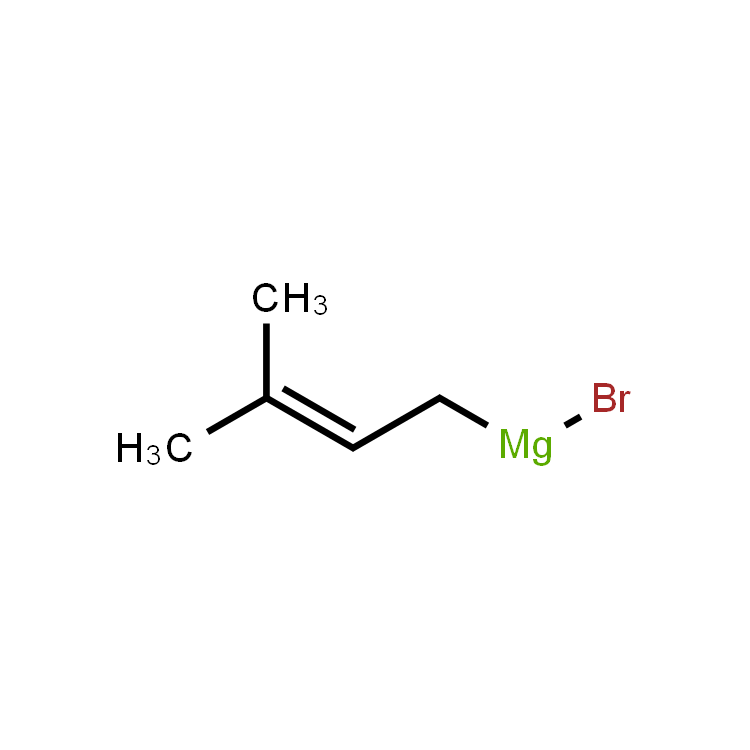
3-Methylbut-2-enylmagnesium bromide、89487-33-2
AI Product Description
*The following content is generated by AI and is for reference only.
3-Methylbut-2-enylmagnesium bromide is a specialized organometallic reagent widely utilized in advanced organic synthesis, particularly within the pharmaceutical and fine chemical industries. Its molecular formula is C5H9BrMg, reflecting its composition as a Grignard reagent derived from 3-methylbut-2-enyl bromide (also known as prenyl bromide) and magnesium metal. The Compound Identification Service (CAS) registry assigns this substance the unique identifier 16084-97-0. This specific Grignard reagent serves as a potent nucleophile, enabling chemists to introduce a prenyl group into various electrophilic substrates with high precision.
The primary utility of 3-methylbut-2-enylmagnesium bromide lies in carbon-carbon bond formation. It reacts efficiently with carbonyl compounds such as aldehydes, ketones, and esters to yield secondary or tertiary alcohols containing a prenyl moiety. Furthermore, it participates in conjugate additions to α,β-unsaturated systems and can be employed in cross-coupling reactions when activated by transition metal catalysts. These capabilities make it indispensable for constructing complex molecular architectures found in natural products, including terpenes, alkaloids, and various bioactive molecules. The presence of the double bond in the allylic position offers additional synthetic versatility, allowing for subsequent functionalization through oxidation or hydrogenation steps.
Handling this reagent requires strict adherence to safety protocols due to its pyrophoric nature and sensitivity to moisture and oxygen. It is typically supplied as a solution in anhydrous ethers, such as tetrahydrofuran (THF) or diethyl ether, under an inert atmosphere like nitrogen or argon. Improper exposure to air can lead to rapid decomposition and potential fire hazards. Consequently, laboratory procedures involving this compound must utilize Schlenk lines or gloveboxes to maintain anhydrous conditions. Despite these handling challenges, its unique reactivity profile ensures its continued relevance in medicinal chemistry research and industrial process development. As a key building block, it facilitates the efficient synthesis of diverse chemical entities, contributing significantly to drug discovery pipelines and materials science applications where precise structural modification is required.











 (All Rights Reserved)
![8-Oxa-1,3-diazaspiro[4.5]decane-2,4-dione](https://eimg.pharmasources.com/image/product/20250403/60fa7223d5a34f24138486ceea0ffb15jpg)
![6,8-Dioxo-5,7-diazaspiro[3.4]octane-2-carboxylic acid](https://eimg.pharmasources.com/image/product/20250403/02effeb5a7639bc84ff1f3add3c0c64fjpg)
![8,16-Diazadispiro[6.1.6.2]heptadecan-17-one](https://eimg.pharmasources.com/image/product/20250403/ca91cba8b87e53fc879f8d8764873a40jpg)