Product Description
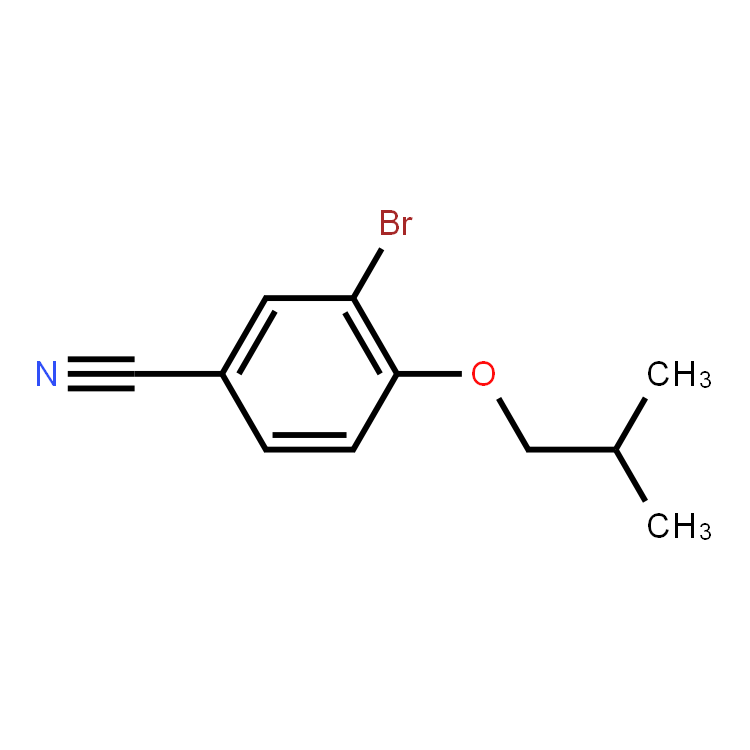
3-bromo-4-(2-methylpropoxy)benzonitrile、208665-95-6
AI Product Description
*The following content is generated by AI and is for reference only.
3-Bromo-4-(2-methylpropoxy)benzonitrile is a specialized organic intermediate widely utilized in the fields of pharmaceutical research, agrochemical synthesis, and materials science. With the chemical formula C11H12BrNO and the CAS registry number 867509-53-9, this compound features a distinctive structural architecture combining a nitrile group, a bromine substituent, and an isobutoxy ether linkage on a benzene ring. This unique combination imparts specific electronic and steric properties that make it highly valuable for advanced synthetic applications.
The primary utility of this molecule lies in its role as a versatile building block for the construction of complex heterocyclic systems and bioactive compounds. In medicinal chemistry, the nitrile moiety serves as a crucial handle for further functionalization, allowing chemists to convert it into amides, carboxylic acids, or tetrazoles through well-established reaction pathways. Simultaneously, the bromine atom acts as an excellent leaving group, facilitating cross-coupling reactions such as Suzuki-Miyaura, Heck, or Sonogashira couplings. These transformations are essential for introducing diverse aromatic or alkenyl fragments, thereby enabling the rapid generation of library compounds for high-throughput screening against various disease targets.
In the agrochemical sector, derivatives of this benzonitrile scaffold are often explored for their potential herbicidal, fungicidal, or insecticidal activities. The presence of the bulky isobutoxy group can significantly influence the lipophilicity and metabolic stability of the final active ingredient, potentially enhancing its efficacy and environmental profile. Furthermore, researchers utilize this intermediate in the development of novel liquid crystal materials and fluorescent probes, where the rigid aromatic core and polar substituents contribute to desired optical and electrochemical characteristics.
Synthetically, 3-bromo-4-(2-methylpropoxy)benzonitrile is typically produced via the Williamson ether synthesis followed by electrophilic bromination or direct substitution methods, ensuring high purity suitable for rigorous industrial standards. Its stability under standard storage conditions allows for convenient handling in laboratory settings. As the demand for innovative drug candidates and sustainable agricultural products continues to grow, this compound remains a critical asset in the toolkit of modern chemical synthesis, bridging the gap between simple precursors and sophisticated functional molecules.











 (All Rights Reserved)
![8-Oxa-1,3-diazaspiro[4.5]decane-2,4-dione](https://eimg.pharmasources.com/image/product/20250403/60fa7223d5a34f24138486ceea0ffb15jpg)
![6,8-Dioxo-5,7-diazaspiro[3.4]octane-2-carboxylic acid](https://eimg.pharmasources.com/image/product/20250403/02effeb5a7639bc84ff1f3add3c0c64fjpg)

![8,16-Diazadispiro[6.1.6.2]heptadecan-17-one](https://eimg.pharmasources.com/image/product/20250403/ca91cba8b87e53fc879f8d8764873a40jpg)