Product Description
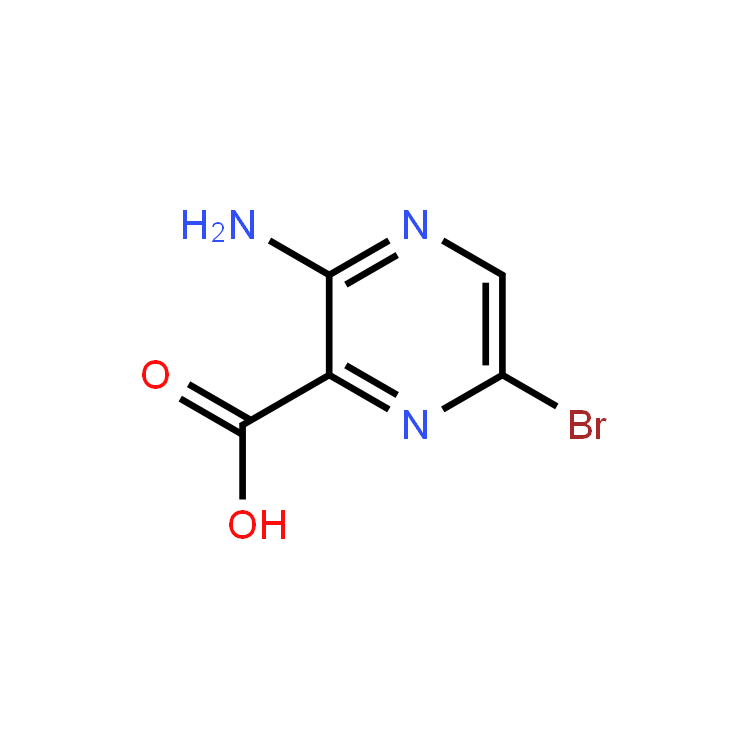
3-amino-6-bromopyrazine-2-carboxylic acid、486424-37-7
AI Product Description
*The following content is generated by AI and is for reference only.
3-Amino-6-bromopyrazine-2-carboxylic acid is a specialized heterocyclic compound widely recognized in the fields of medicinal chemistry and organic synthesis. Its molecular formula is C5H4BrN3O2, reflecting a pyrazine ring substituted with an amino group at the 3-position, a bromine atom at the 6-position, and a carboxylic acid moiety at the 2-position. The Compound is typically identified by CAS Registry Number 100397-84-8, which facilitates its precise tracking in chemical databases and inventory systems.
This molecule serves as a critical intermediate in the development of bioactive pharmaceuticals and agrochemicals. The presence of the bromine atom makes it an ideal substrate for palladium-catalyzed cross-coupling reactions, such as Suzuki-Miyaura or Buchwald-Hartwig couplings, allowing chemists to attach diverse aryl or alkyl groups to the pyrazine core. Furthermore, the amino and carboxylic acid functionalities provide versatile handles for further derivatization, enabling the construction of complex amides, esters, or hydrazides. Researchers frequently utilize this building block to synthesize novel kinase inhibitors, antitumor agents, and potential antibiotics, leveraging the inherent biological activity often associated with halogenated pyrazine scaffolds.
The compound is generally supplied as a white to off-white crystalline solid, requiring storage under inert atmosphere conditions to prevent degradation from moisture or oxidation. While not a commodity chemical, it holds significant value in academic research laboratories and industrial R&D departments focused on drug discovery. Its unique structural features allow for the fine-tuning of physicochemical properties in target molecules, including solubility and metabolic stability. As the demand for targeted therapies grows, derivatives based on 3-amino-6-bromopyrazine-2-carboxylic acid are expected to play an increasingly important role in creating next-generation therapeutics with improved efficacy and selectivity profiles.





 (All Rights Reserved)
![8-Oxa-1,3-diazaspiro[4.5]decane-2,4-dione](https://eimg.pharmasources.com/image/product/20250403/60fa7223d5a34f24138486ceea0ffb15jpg)
![6,8-Dioxo-5,7-diazaspiro[3.4]octane-2-carboxylic acid](https://eimg.pharmasources.com/image/product/20250403/02effeb5a7639bc84ff1f3add3c0c64fjpg)
![8,16-Diazadispiro[6.1.6.2]heptadecan-17-one](https://eimg.pharmasources.com/image/product/20250403/ca91cba8b87e53fc879f8d8764873a40jpg)