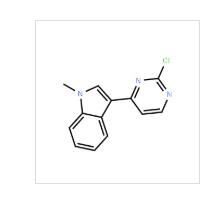
Product name: 3-(2-chloropyrimidin-4-yl)-1-Methylindole
Synonymous: 3-(2-chloropyriMidin-4-yl)-1-Methylindole;3-(2-chloropyriMidin-4-yl)-1-Methyl-1H-indole;3-(2-Chloro-4-pyrimidinyl)-1-methyl-1H-indole;EOS-61220;elagolixintermediate11;3-(2-Chloro-4-pyrimidyl)-1-methylindole
CAS No.: 1032452-86-0
Molecular formula: C13H10ClN3
Molecular weight: 243.6916
EINECS No.: 806-155-8
Application: Osimertinib(AZD9291)’s intermediate
*The following content is generated by AI and is for reference only.
3-(2-Chloropyrimidin-4-yl)-1-Methylindole is a sophisticated heterocyclic organic compound widely recognized in medicinal chemistry and pharmaceutical research for its unique structural features. With the molecular formula C15H11ClN4, this molecule combines an indole core substituted with a methyl group at the nitrogen position and a 2-chloropyrimidine ring attached at the C3 position. The Chemical Abstracts Service (CAS) registry number for this specific compound is 1006789-94-5. Its chemical structure is particularly valuable due to the presence of the electrophilic chlorine atom on the pyrimidine ring, which serves as a versatile handle for nucleophilic substitution reactions. This reactivity allows chemists to readily introduce various amine functionalities, making it an ideal intermediate for synthesizing complex libraries of bioactive molecules.
The primary application of 3-(2-chloropyrimidin-4-yl)-1-Methylindole lies in the discovery and development of novel kinase inhibitors and other enzyme modulators. Many modern therapeutic agents target specific protein kinases involved in cell signaling pathways associated with cancer, inflammation, and autoimmune disorders. By utilizing this scaffold, researchers can rapidly generate analogs to optimize binding affinity, selectivity, and pharmacokinetic properties. Furthermore, the indole moiety is a privileged structure found in numerous natural products and approved drugs, contributing to favorable metabolic stability and membrane permeability. Consequently, this compound serves as a critical building block in fragment-based drug design strategies. It is typically handled under inert atmospheres due to potential sensitivity to moisture and light, ensuring the integrity of the reactive chloro-pyrimidine linkage during synthesis. While not yet a standalone commercial drug, its role as a synthetic precursor is indispensable in academic laboratories and biopharmaceutical R&D departments aiming to accelerate the pipeline of new therapeutic candidates. Researchers continue to explore its derivatives to address unmet medical needs, highlighting its enduring significance in contemporary organic synthesis and medicinal chemistry.





 (All Rights Reserved)
![Pyrrolo[2,3-d]pyrimidin-4-ol](https://eimg.pharmasources.com/image/20250423/cvXgKDastRYgD63GYBroAOcjpuRzGHJvGxhaKgvA.gif)
![4-Chloro-7H-pyrrolo[2,3-d]pyrimidine](https://eimg.pharmasources.com/image/20250423/Vo6dULaYnbLZCd7lJ7013faOnpM4iolBbJyR708d.gif)
![1,6-dihydro-5-hydroxy-1-methyl-2-[1-methyl-1-[[(phenylmethoxy)carbonyl]amino]ethyl]-6-oxo-4-Pyrimidi](https://eimg.pharmasources.com/image/20240312/35lb1ifZuXM3CbTyv7zwyPrhcXy4bmyDTBeUKkDN.gif)

![Diethyl-2-acetamido-2-(7-chloro-5-(2-fluorophenyl)-3H- benzo[e][1,4]diazepin-2-yl)malonate](https://eimg.pharmasources.com/image/20240603/kCK1tVKXvO7mdpLTBNii5x61NUulXBiqHBf6clcn.png)