Product Description
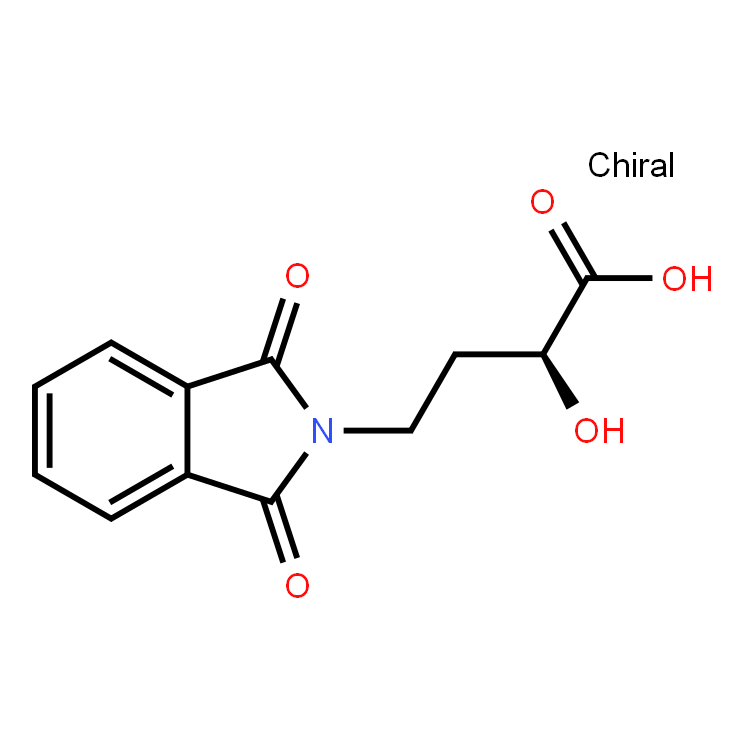
(2S)-4-(1,3-Dioxoisoindolin-2-yl)-2-hydroxybutanoic acid、48172-10-7
AI Product Description
*The following content is generated by AI and is for reference only.
(2S)-4-(1,3-Dioxoisoindolin-2-yl)-2-hydroxybutanoic acid is a sophisticated chiral organic intermediate primarily utilized in the pharmaceutical and fine chemical industries. Characterized by its specific stereochemistry at the C2 position, this compound features a phthalimide moiety linked to a hydroxybutanoic acid backbone. Its molecular formula is C₁₂H₁₁NO₅, and it carries the CAS Registry Number 105698-76-6. The presence of the chiral center makes this molecule particularly valuable for asymmetric synthesis, where the (S)-configuration is often critical for biological activity and pharmacological efficacy.
The primary application of this substance lies in the development of advanced drug candidates. It serves as a key building block for synthesizing complex heterocyclic compounds, including various amino acid derivatives and peptidomimetics. In medicinal chemistry, such intermediates are frequently employed to construct molecules targeting specific enzymatic pathways or receptor sites. The phthalimide group acts as a versatile protecting group for amines, allowing chemists to manipulate other functional groups on the molecule without interference, which is essential in multi-step synthetic routes. Furthermore, the carboxylic acid and hydroxyl functionalities provide points for further derivatization, enabling the creation of diverse analogs with optimized physicochemical properties.
Due to its high optical purity requirements, the production of (2S)-4-(1,3-Dioxoisoindolin-2-yl)-2-hydroxybutanoic acid typically involves rigorous enantioselective synthesis methods or chiral resolution techniques. Researchers utilize this compound to explore structure-activity relationships (SAR) in drug discovery programs, aiming to enhance potency, selectivity, and metabolic stability. While not a final therapeutic agent itself, its role as a precursor is indispensable in the manufacturing pipeline for novel therapeutics. Safety data indicates that like many organic intermediates containing imide structures, it requires careful handling to avoid skin irritation or inhalation risks. Overall, this chiral acid represents a vital tool in modern organic synthesis, bridging the gap between simple precursors and complex bioactive agents.





 (All Rights Reserved)
![8-Oxa-1,3-diazaspiro[4.5]decane-2,4-dione](https://eimg.pharmasources.com/image/product/20250403/60fa7223d5a34f24138486ceea0ffb15jpg)
![6,8-Dioxo-5,7-diazaspiro[3.4]octane-2-carboxylic acid](https://eimg.pharmasources.com/image/product/20250403/02effeb5a7639bc84ff1f3add3c0c64fjpg)


![8,16-Diazadispiro[6.1.6.2]heptadecan-17-one](https://eimg.pharmasources.com/image/product/20250403/ca91cba8b87e53fc879f8d8764873a40jpg)