Product Description
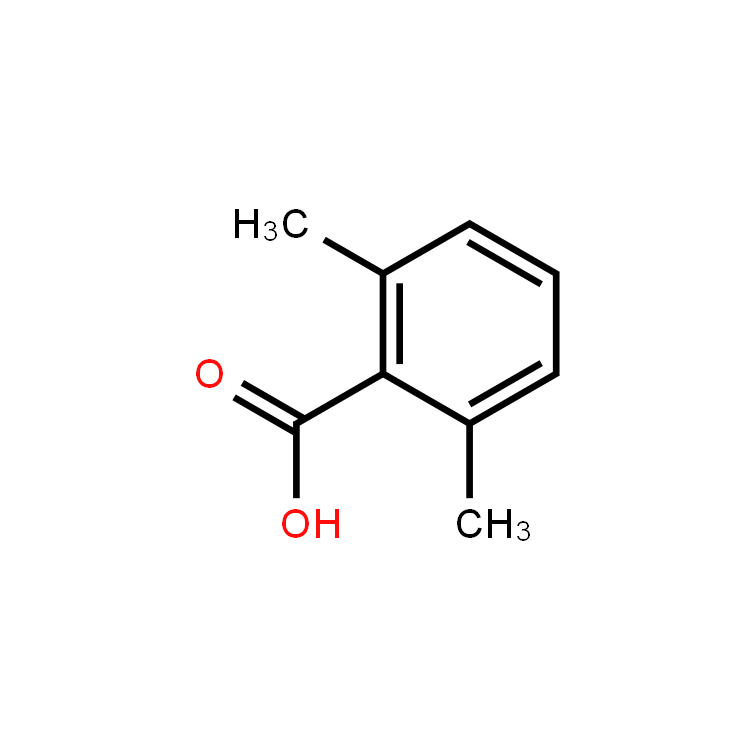
2,6-Dimethylbenzoic acid、632-46-2
AI Product Description
*The following content is generated by AI and is for reference only.
2,6-Dimethylbenzoic acid is a specialized aromatic carboxylic acid widely utilized in organic synthesis and industrial chemistry. With the molecular formula C9H10O2 and a CAS registry number of 578-94-3, this compound features a benzene ring substituted with two methyl groups at the ortho positions relative to the carboxyl group. This unique structural arrangement significantly influences its physical properties, including melting point and solubility characteristics, distinguishing it from other benzoic acid derivatives.
Primarily, 2,6-dimethylbenzoic acid serves as a crucial intermediate in the pharmaceutical industry. It acts as a building block for synthesizing various active pharmaceutical ingredients (APIs), particularly those requiring specific steric hindrance or lipophilicity profiles. The presence of the ortho-methyl groups can modulate the metabolic stability and binding affinity of drug candidates, making it valuable in medicinal chemistry research. Furthermore, the compound finds applications in the production of high-performance polymers and resins. Its derivative esters are sometimes employed as plasticizers or monomers to enhance the thermal stability and mechanical strength of polymeric materials used in automotive and aerospace sectors.
In agrochemical formulations, this chemical is explored for developing novel herbicides and fungicides, where its specific substitution pattern offers enhanced biological activity against target pests while minimizing environmental persistence. Additionally, researchers utilize 2,6-dimethylbenzoic acid as a standard reference material in analytical chemistry for calibrating chromatographic instruments and validating separation techniques due to its well-defined spectral properties. The compound is typically available as a white to off-white crystalline powder, stable under standard storage conditions but sensitive to strong bases which may lead to salt formation. Safety data indicates that while generally low in acute toxicity, appropriate handling procedures involving protective equipment are recommended to prevent skin irritation or inhalation hazards during processing. As demand grows for complex organic molecules in advanced manufacturing, 2,6-dimethylbenzoic acid remains an essential reagent bridging fundamental research and commercial application across multiple high-tech industries.





 (All Rights Reserved)
![8-Oxa-1,3-diazaspiro[4.5]decane-2,4-dione](https://eimg.pharmasources.com/image/product/20250403/60fa7223d5a34f24138486ceea0ffb15jpg)
![6,8-Dioxo-5,7-diazaspiro[3.4]octane-2-carboxylic acid](https://eimg.pharmasources.com/image/product/20250403/02effeb5a7639bc84ff1f3add3c0c64fjpg)
![8,16-Diazadispiro[6.1.6.2]heptadecan-17-one](https://eimg.pharmasources.com/image/product/20250403/ca91cba8b87e53fc879f8d8764873a40jpg)