Product Description
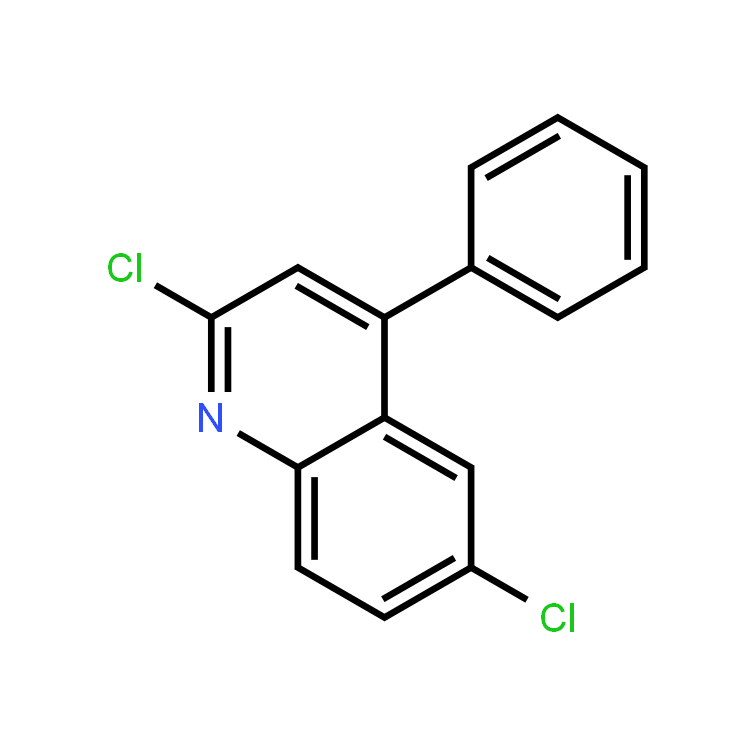
2,6-Dichloro-4-phenylquinoline、10352-30-4
AI Product Description
*The following content is generated by AI and is for reference only.
2,6-Dichloro-4-phenylquinoline is a versatile heterocyclic intermediate widely utilized in the fields of medicinal chemistry, agrochemicals, and materials science. With the molecular formula C15H9Cl2N and a CAS Registry Number of 103735-86-4, this compound features a quinoline core substituted with two chlorine atoms at the second and sixth positions and a phenyl group at the fourth position. This specific substitution pattern imparts unique electronic and steric properties, making it an invaluable building block for synthesizing complex bioactive molecules.
The primary application of 2,6-dichloro-4-phenylquinoline lies in its role as a precursor for pharmaceutical agents. The reactive chlorine atoms at the 2 and 6 positions are highly susceptible to nucleophilic substitution reactions, allowing chemists to easily introduce various amine, thiol, or alkoxy groups. This reactivity facilitates the rapid construction of diverse quinoline derivatives known for their potent biological activities, including antibacterial, antifungal, antimalarial, and anticancer properties. Furthermore, the phenyl substituent enhances lipophilicity and can improve binding affinity within specific enzyme active sites, optimizing the pharmacokinetic profile of potential drug candidates.
Beyond medicine, this compound serves as a critical scaffold in the development of advanced functional materials. Its rigid aromatic structure and electron-deficient nature make it suitable for use in organic light-emitting diodes (OLEDs) and fluorescent sensors. Researchers utilize it to tune the energy levels and emission colors of luminescent materials, contributing to the advancement of next-generation display technologies and optical devices. Additionally, in agrochemical research, quinoline-based structures derived from this intermediate have shown promise as fungicides and insecticides, offering effective protection for crops against various pests and diseases while maintaining environmental safety profiles.
Overall, 2,6-dichloro-4-phenylquinoline stands out as a multifunctional chemical entity. Its structural versatility enables extensive derivatization, bridging the gap between fundamental organic synthesis and practical industrial applications. Whether serving as a key step in drug discovery pipelines or a component in high-tech material formulations, this compound remains essential for innovation across multiple scientific disciplines.











 (All Rights Reserved)
![8-Oxa-1,3-diazaspiro[4.5]decane-2,4-dione](https://eimg.pharmasources.com/image/product/20250403/60fa7223d5a34f24138486ceea0ffb15jpg)
![6,8-Dioxo-5,7-diazaspiro[3.4]octane-2-carboxylic acid](https://eimg.pharmasources.com/image/product/20250403/02effeb5a7639bc84ff1f3add3c0c64fjpg)
![8,16-Diazadispiro[6.1.6.2]heptadecan-17-one](https://eimg.pharmasources.com/image/product/20250403/ca91cba8b87e53fc879f8d8764873a40jpg)