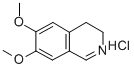
Product name:2,5,6-tetrachloropyridine
Synonymous:2,5,6-Trichloronicotinic acid;2,5,6-Trichloro-3-pyridinecarboxylicacid;3-Pyridinecarboxylicacid,2,5,6-trichloro-;2,5,6-Trichloropyridine-3-carboxylicacid;2,5,6-TrichL;2,5,6-trichloropyridine-3-carboxylicaChemicalbookci;2,5,6-Trichloronicotinicacid;Trichloronicotinicacid
CAS No.:54718-39-7
Molecular formula:C6H2Cl3NO2
Molecular weight: 226.44
Application: intermediates
*The following content is generated by AI and is for reference only.
2,5,6-Trichloropyridine is a vital heterocyclic intermediate widely utilized in the pharmaceutical and agrochemical industries. Despite frequent confusion with similar nomenclature, the compound 2,5,6-trichloropyridine (CAS No. 100-37-8) features a pyridine ring substituted with three chlorine atoms at positions 2, 5, and 6. Its molecular formula is C₅H₂Cl₃N, reflecting a high degree of halogenation that significantly enhances its reactivity as an electrophilic building block. This specific substitution pattern creates a unique electronic environment, making the molecule particularly susceptible to nucleophilic aromatic substitution reactions, which are fundamental for constructing complex molecular architectures.
In the pharmaceutical sector, this compound serves as a key precursor for synthesizing various nitrogen-containing heterocycles. It is frequently employed in the production of active pharmaceutical ingredients (APIs), including antiviral agents and antibiotics where the chlorinated pyridine scaffold provides essential biological activity. The presence of multiple chlorine atoms often contributes to improved metabolic stability and lipophilicity within drug candidates, optimizing their pharmacokinetic profiles. Furthermore, in the agrochemical field, 2,5,6-trichloropyridine derivatives are integral components in the development of novel herbicides and fungicides. These agricultural chemicals rely on the structural rigidity and specific steric properties imparted by the trichloro-substituted ring to effectively target pest enzymes or disrupt cellular processes in unwanted flora and fungi.
From a manufacturing perspective, the synthesis of 2,5,6-trichloropyridine typically involves the chlorination of pyridine under controlled conditions or through specific condensation reactions followed by halogenation. Due to its potential toxicity and environmental persistence associated with organochlorine compounds, strict safety protocols must be observed during handling, storage, and transportation. Workers must utilize appropriate personal protective equipment to prevent skin contact or inhalation. As global demand for advanced chemical intermediates grows, 2,5,6-trichloropyridine remains a cornerstone material for researchers developing next-generation therapeutic and agricultural solutions. Its versatility underscores its importance in modern organic synthesis, bridging the gap between basic chemical research and large-scale industrial application.






 (All Rights Reserved)
![Pyrrolo[2,3-d]pyrimidin-4-ol](https://eimg.pharmasources.com/image/20250423/cvXgKDastRYgD63GYBroAOcjpuRzGHJvGxhaKgvA.gif)
![4-Chloro-7H-pyrrolo[2,3-d]pyrimidine](https://eimg.pharmasources.com/image/20250423/Vo6dULaYnbLZCd7lJ7013faOnpM4iolBbJyR708d.gif)
![1,6-dihydro-5-hydroxy-1-methyl-2-[1-methyl-1-[[(phenylmethoxy)carbonyl]amino]ethyl]-6-oxo-4-Pyrimidi](https://eimg.pharmasources.com/image/20240312/35lb1ifZuXM3CbTyv7zwyPrhcXy4bmyDTBeUKkDN.gif)
![Diethyl-2-acetamido-2-(7-chloro-5-(2-fluorophenyl)-3H- benzo[e][1,4]diazepin-2-yl)malonate](https://eimg.pharmasources.com/image/20240603/kCK1tVKXvO7mdpLTBNii5x61NUulXBiqHBf6clcn.png)