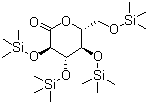
Dapagliflozin intermediate 2; 2,3,4,6-tetra-O-trimethylsilyl-D-glucopyrano-1,5-lactone; 2,3,4,6-tetra- O-trisilyl-D-gluconolactone; 2,3,4,6-tetra-O-trimethylsilyl-D-glucopyrano-1,5-lactone
CAS RN 32384-65-9
*The following content is generated by AI and is for reference only.
2,3,4,6-Tetrakis-O-trimethylsilyl-D-gluconolactone is a highly specialized organosilicon derivative of D-gluconic acid lactone. This compound features the complete silylation of all four hydroxyl groups on the gluconolactone ring with trimethylsilyl (TMS) substituents. Its molecular formula is C15H32O4Si4, reflecting the addition of four bulky silyl groups to the parent sugar structure. The Compound typically carries a CAS registry number of 17890-46-7, which serves as its unique identifier for chemical databases and safety documentation.
The primary application of this reagent lies in advanced analytical chemistry, specifically within gas chromatography (GC) and mass spectrometry (MS). Native carbohydrates and their derivatives possess multiple polar hydroxyl groups that render them non-volatile and thermally unstable under standard GC conditions. By converting these polar functionalities into lipophilic trimethylsilyl ethers, chemists significantly enhance volatility and thermal stability. This derivatization allows for the precise separation, identification, and quantification of complex sugar mixtures that would otherwise be impossible to analyze using conventional gas-phase techniques. Consequently, it is an indispensable tool in food science for analyzing sweeteners, in clinical diagnostics for detecting metabolic disorders involving sugar metabolism, and in pharmaceutical research for characterizing glycosylation patterns.
Beyond analysis, this specific lactone derivative serves as a valuable intermediate in organic synthesis. The protected lactone functionality offers a stable platform for further chemical modifications, enabling the construction of complex oligosaccharides or glycoconjugates with high stereochemical fidelity. The TMS groups act as robust protecting groups during multi-step synthetic sequences, preventing unwanted side reactions at the hydroxyl positions while maintaining the integrity of the carbonyl group. Researchers utilize this molecule to study reaction mechanisms involving carbohydrate activation and to develop novel biomaterials. Due to the sensitivity of silyl ethers to moisture, handling requires strictly anhydrous conditions and inert atmospheres to prevent hydrolysis back to the parent lactone. Overall, 2,3,4,6-Tetrakis-O-trimethylsilyl-D-gluconolactone represents a critical bridge between natural carbohydrate structures and modern instrumental analysis, facilitating deeper insights into biological systems and synthetic pathways.





 (All Rights Reserved)
![8-Oxa-1,3-diazaspiro[4.5]decane-2,4-dione](https://eimg.pharmasources.com/image/product/20250403/60fa7223d5a34f24138486ceea0ffb15jpg)
![8,16-Diazadispiro[6.1.6.2]heptadecan-17-one](https://eimg.pharmasources.com/image/product/20250403/ca91cba8b87e53fc879f8d8764873a40jpg)
![6,8-Dioxo-5,7-diazaspiro[3.4]octane-2-carboxylic acid](https://eimg.pharmasources.com/image/product/20250403/02effeb5a7639bc84ff1f3add3c0c64fjpg)
