Product Description
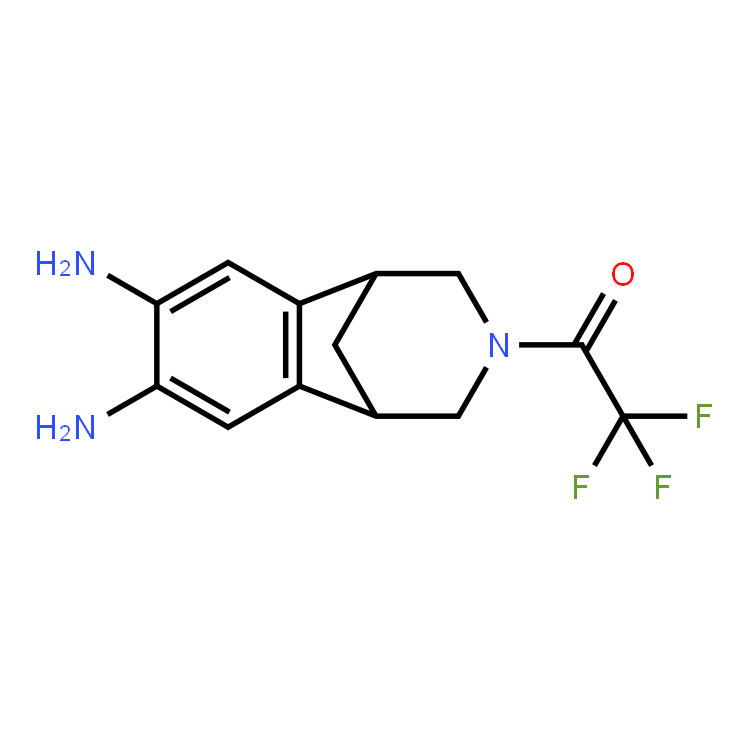
2,3,4,5-Tetrahydro-3-(trifluoroacetyl)-1,5-methano-1H-3-benzazepine-7,8-diamine、230615-69-7
AI Product Description
*The following content is generated by AI and is for reference only.
2,3,4,5-Tetrahydro-3-(trifluoroacetyl)-1,5-methano-1H-3-benzazepine-7,8-diamine is a specialized organic compound characterized by a complex tricyclic framework incorporating a methano-bridged benzazepine core. This molecule features a trifluoroacetyl substituent at the C-3 position and two amino groups located at the 7 and 8 positions of the aromatic ring, creating a unique pharmacophore with significant potential in medicinal chemistry research. While specific commercial availability may be limited to niche chemical suppliers or custom synthesis services, its structural attributes suggest high utility as a scaffold for drug discovery programs targeting central nervous system disorders.
The presence of the electron-withdrawing trifluoroacetyl group enhances metabolic stability and modulates lipophilicity, which are critical parameters for optimizing blood-brain barrier penetration. The diamine functionality offers versatile sites for further derivatization, allowing chemists to construct diverse libraries of analogues through amide coupling or reductive amination reactions. Consequently, this compound serves primarily as an intermediate or lead structure in the development of novel neuroactive agents, including potential antagonists for opioid receptors, serotonin modulators, or ligands for other G-protein coupled receptors. Its rigid bicyclic methano-bridge restricts conformational flexibility, potentially improving binding affinity and selectivity compared to more flexible acyclic counterparts.
Currently, no widely recognized CAS registry number is publicly associated with this exact nomenclature in major open databases, indicating it may be a proprietary intermediate or a recently synthesized entity not yet assigned a standard identifier. Researchers utilizing this material typically employ it in vitro for receptor binding assays or in vivo models to evaluate efficacy against pain, addiction, or anxiety. Safety handling requires standard laboratory precautions due to the reactivity of the amine groups and the potential toxicity associated with fluorinated organic compounds. As a highly functionalized building block, it represents a sophisticated tool for advancing structural biology and rational drug design, offering insights into structure-activity relationships within the benzazepine class of heterocycles. Future applications may expand into diagnostic imaging probes or targeted therapeutics once optimized derivatives demonstrate favorable pharmacokinetic profiles in preclinical trials.











 (All Rights Reserved)
![8-Oxa-1,3-diazaspiro[4.5]decane-2,4-dione](https://eimg.pharmasources.com/image/product/20250403/60fa7223d5a34f24138486ceea0ffb15jpg)
![6,8-Dioxo-5,7-diazaspiro[3.4]octane-2-carboxylic acid](https://eimg.pharmasources.com/image/product/20250403/02effeb5a7639bc84ff1f3add3c0c64fjpg)
![8,16-Diazadispiro[6.1.6.2]heptadecan-17-one](https://eimg.pharmasources.com/image/product/20250403/ca91cba8b87e53fc879f8d8764873a40jpg)