like wihite powder,
>99%
the iintermediate can be used in pharmaceutical synthesis and Oled materials synthesis.
We researched & produced oled more than ten years. We provide simiilar OLED structure customization.
*The following content is generated by AI and is for reference only.
2-Methoxy-9H-carbazole is a specialized organic compound belonging to the carbazole family, widely recognized in advanced materials science and pharmaceutical research. Its molecular formula is C14H13NO, and it carries the CAS registry number 57896-96-7. Structurally, this molecule consists of a tricyclic carbazole core substituted with a methoxy group at the second position, which significantly alters its electronic properties compared to unsubstituted carbazole. The presence of the methoxy moiety enhances electron-donating capabilities, making it an ideal candidate for applications requiring high charge transport efficiency.
In the realm of organic electronics, 2-methoxy-9H-carbazole serves as a critical building block for synthesizing hole-transporting materials used in organic light-emitting diodes (OLEDs) and organic photovoltaics (OPVs). Its unique energy levels facilitate efficient hole injection and transport, thereby improving device stability and luminous efficiency. Researchers frequently utilize this compound as a precursor or intermediate in developing novel emitters for next-generation display technologies, where color purity and operational longevity are paramount.
Beyond electronics, the compound finds relevance in medicinal chemistry and agrochemical synthesis. The carbazole scaffold is known for its diverse biological activities, including anti-inflammatory, anticancer, and antimicrobial properties. By introducing the methoxy group at the C-2 position, chemists can fine-tune the lipophilicity and metabolic stability of potential drug candidates, optimizing their pharmacokinetic profiles. Additionally, it acts as a versatile ligand in transition metal catalysis, aiding in cross-coupling reactions that construct complex molecular architectures.
While primarily utilized in industrial R&D settings, 2-methoxy-9H-carbazole remains a valuable tool for exploring structure-property relationships in heterocyclic chemistry. Its synthesis typically involves electrophilic substitution on carbazole or specific coupling strategies followed by demethylation control. As the demand for high-performance organic semiconductors grows, this derivative stands out as a key material for advancing sustainable energy solutions and innovative therapeutic agents. Careful handling is required during processing due to its chemical reactivity, but its contribution to technological progress is undeniable.

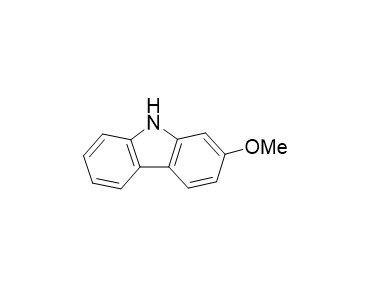




 (All Rights Reserved)
![(6-phenyldibenzo[b,d]thiophen-4-yl)boronic acid](https://eimg.pharmasources.com/image/20250918/VzkRtcz9igDw870AqZ3zYo3SOO3IOeqwh9VdEbLS.png)

![[1,1':4',1''-Terphenyl]-2,6-diol, 2'-fluoro-](https://eimg.pharmasources.com/image/20240314/BTJGUNOZ2gmyX3HLfV4HO89Qpi7WQfGsPD1Qh3Az.jpeg)



![3-Bromo-5-tert-butylbenzo[b]thiophene](https://eimg.pharmasources.com/image/product/20250919/742a9f6c2521018bdd155a4ef08a8873jpg)
![Ethyl 5-methylbenzo[b]thiophene-2-carboxylate](https://eimg.pharmasources.com/image/product/20250919/bd4b4317408ace91b597157b395c106bjpg)
![5-Hydroxy-3,9-dimethyl-7H-benzo[c]fluoren-7-one](https://eimg.pharmasources.com/image/product/20250919/d01931f02fb1e7e8231c9933d73e3837jpg)
![3-Iodo-5-tert-butylbenzo[b]thiophene](https://eimg.pharmasources.com/image/product/20250919/370cd976e4b82e45e310eab5fdf6b1f1jpg)
