Product Description
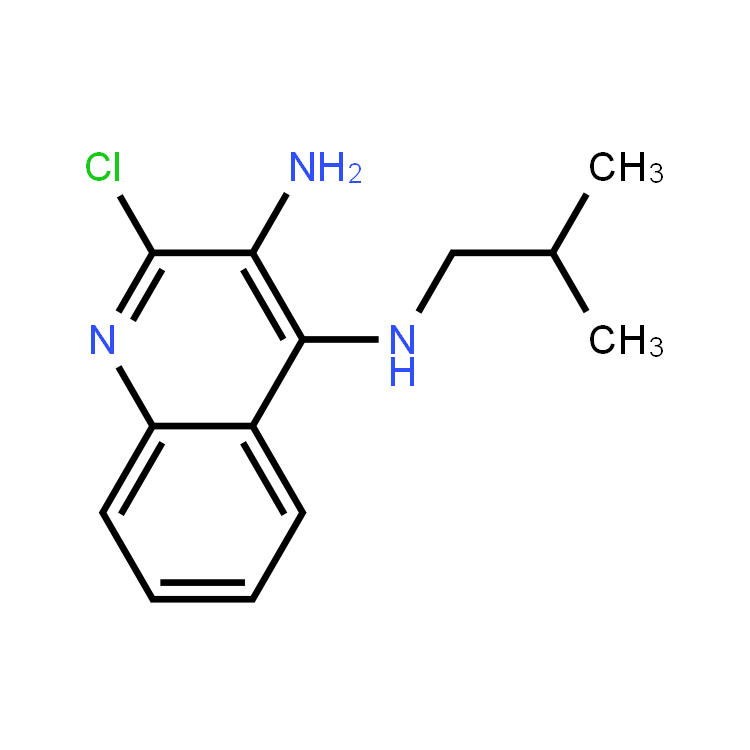
2-Chloro-N4-isobutylquinoline-3,4-diamine、133860-76-1
AI Product Description
*The following content is generated by AI and is for reference only.
2-Chloro-N4-isobutylquinoline-3,4-diamine is a specialized heterocyclic organic compound widely utilized in the pharmaceutical and agrochemical industries as a critical intermediate for synthesizing complex bioactive molecules. With the chemical formula C13H15ClN4 and a molecular weight of approximately 262.74 g/mol, this substance features a quinoline core substituted with a chlorine atom at the second position and an isobutylamino group attached to the fourth nitrogen, alongside an amino group at the third position. This unique structural configuration imparts significant reactivity, making it highly valuable for nucleophilic substitution reactions and further functionalization processes essential in drug discovery pipelines.
The primary application of 2-chloro-N4-isobutylquinoline-3,4-diamine lies in its role as a building block for developing kinase inhibitors, anti-inflammatory agents, and potential anticancer therapeutics. The presence of the chloro substituent allows for facile displacement by various nucleophiles, enabling chemists to construct diverse derivatives with tailored biological activities. Furthermore, its diamine motif serves as a versatile scaffold for creating fused ring systems or coordinating with metal ions, which is particularly useful in materials science and catalysis research. In agricultural chemistry, analogous structures derived from this precursor have shown promise as herbicides or fungicides due to their ability to disrupt specific enzymatic pathways in pests and pathogens.
Safety protocols are paramount when handling this compound, as it may exhibit irritant properties upon contact with skin or eyes and should be managed within a fume hood using appropriate personal protective equipment. While specific commercial catalog numbers vary by supplier, researchers often seek high-purity grades (typically exceeding 98%) to ensure reproducible results in synthetic workflows. As global demand for novel therapeutic agents accelerates, intermediates like 2-chloro-N4-isobutylquinoline-3,4-diamine remain indispensable tools for medicinal chemists striving to bridge the gap between theoretical design and clinical efficacy. Its versatility continues to drive innovation across multiple sectors, underscoring its status as a cornerstone molecule in modern organic synthesis.











 (All Rights Reserved)
![8-Oxa-1,3-diazaspiro[4.5]decane-2,4-dione](https://eimg.pharmasources.com/image/product/20250403/60fa7223d5a34f24138486ceea0ffb15jpg)
![6,8-Dioxo-5,7-diazaspiro[3.4]octane-2-carboxylic acid](https://eimg.pharmasources.com/image/product/20250403/02effeb5a7639bc84ff1f3add3c0c64fjpg)
![8,16-Diazadispiro[6.1.6.2]heptadecan-17-one](https://eimg.pharmasources.com/image/product/20250403/ca91cba8b87e53fc879f8d8764873a40jpg)