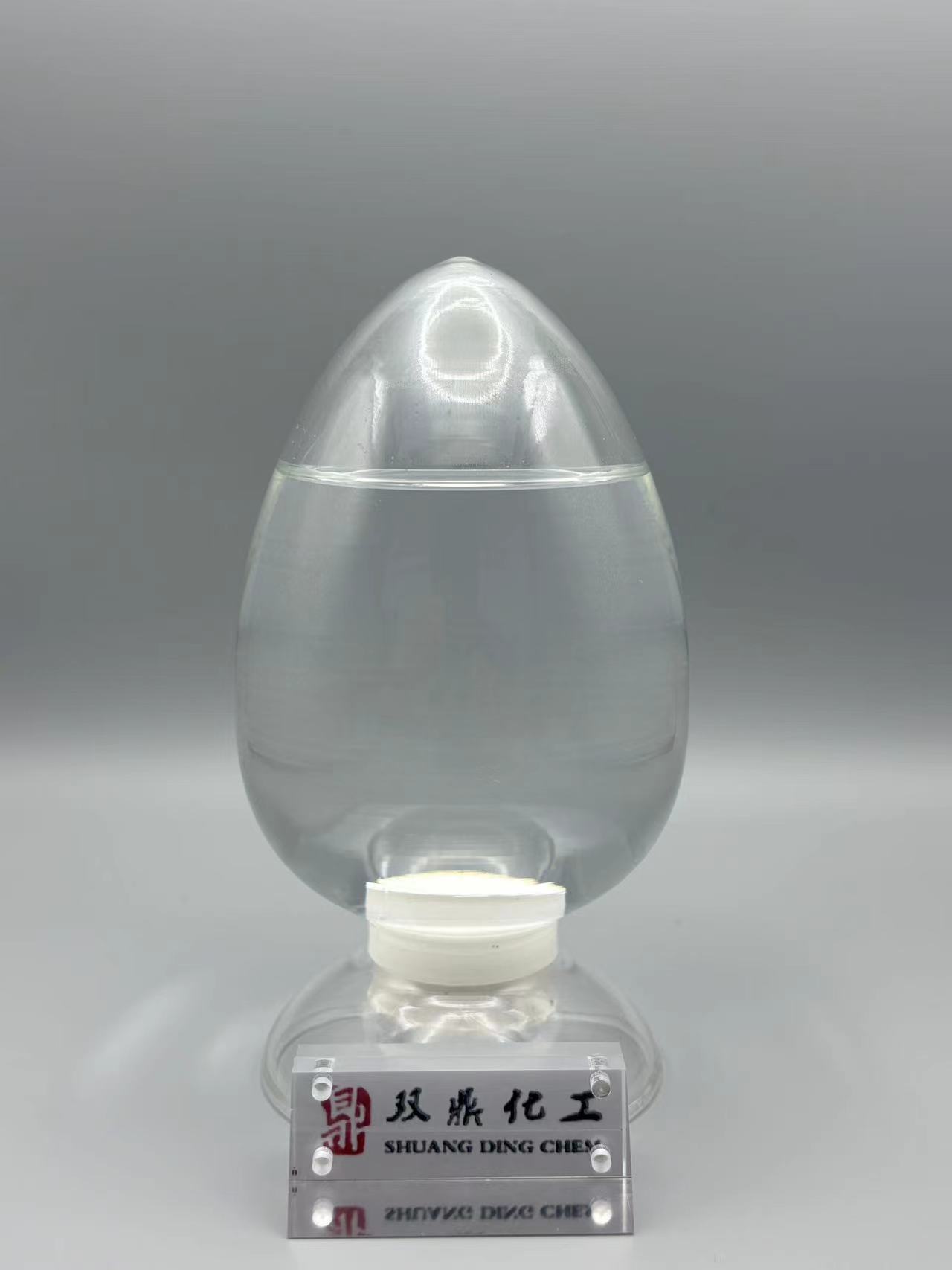
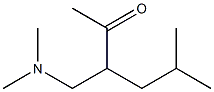
purity >98.5%
D ratio>98%
powder,
Cas: 1480589-62-5
the iintermediate can be used in pharmaceutical synthesis and Oled materials synthesis.
We researched & produced oled more than ten years. We provide simiilar OLED structure customization.
*The following content is generated by AI and is for reference only.
2-Chloro-D4-phenyl-1,3,5-triazine is a specialized deuterated organic compound widely utilized in advanced chemical research and analytical sciences. Its molecular formula is C8H2ClD3N3, reflecting the substitution of three hydrogen atoms on the phenyl ring with deuterium isotopes, while retaining the core 1,3,5-triazine structure and a reactive chlorine substituent at the second position. This molecule corresponds to CAS Registry Number 1267096-48-5, a unique identifier essential for precise cataloging and regulatory compliance in global laboratories.
The primary application of this compound lies in its role as an internal standard for mass spectrometry (MS) and nuclear magnetic resonance (NMR) spectroscopy. Due to the stable nature of the carbon-deuterium bond, it exhibits distinct spectral signatures that do not overlap with common proton-based signals found in biological or environmental samples. This characteristic allows researchers to accurately quantify trace analytes by compensating for matrix effects and instrument variability during complex analyses. In pharmaceutical development, it serves as a critical tool for studying metabolic pathways, enabling scientists to track drug metabolism without interference from endogenous compounds.
Furthermore, the presence of the chloro group renders the molecule highly versatile as a synthetic intermediate. It acts as an electrophilic precursor in nucleophilic aromatic substitution reactions, facilitating the introduction of various functional groups onto the triazine scaffold. This property makes it valuable in the synthesis of novel agrochemicals, high-performance polymers, and advanced optical materials. The deuterated variant specifically aids in mechanistic studies where kinetic isotope effects are investigated to understand reaction dynamics at the atomic level.
In environmental monitoring, this reagent assists in the detection of persistent organic pollutants, offering enhanced sensitivity and specificity compared to non-deuterated analogues. Its stability under diverse conditions ensures reliable performance across different experimental setups. As the demand for precision in chemical analysis grows, 2-chloro-D4-phenyl-1,3,5-triazine remains an indispensable asset for chemists striving for accuracy in structural elucidation and quantitative measurements. Its unique combination of isotopic labeling and reactive functionality continues to drive innovation in both academic research and industrial applications.

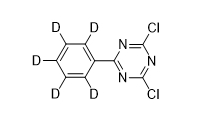




 (All Rights Reserved)
![(6-phenyldibenzo[b,d]thiophen-4-yl)boronic acid](https://eimg.pharmasources.com/image/20250918/VzkRtcz9igDw870AqZ3zYo3SOO3IOeqwh9VdEbLS.png)
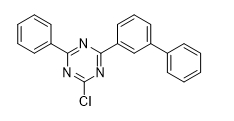

![[1,1':4',1''-Terphenyl]-2,6-diol, 2'-fluoro-](https://eimg.pharmasources.com/image/20240314/BTJGUNOZ2gmyX3HLfV4HO89Qpi7WQfGsPD1Qh3Az.jpeg)

![Diethyl-2-acetamido-2-(7-chloro-5-(2-fluorophenyl)-3H- benzo[e][1,4]diazepin-2-yl)malonate](https://eimg.pharmasources.com/image/20240603/kCK1tVKXvO7mdpLTBNii5x61NUulXBiqHBf6clcn.png)