Product Description
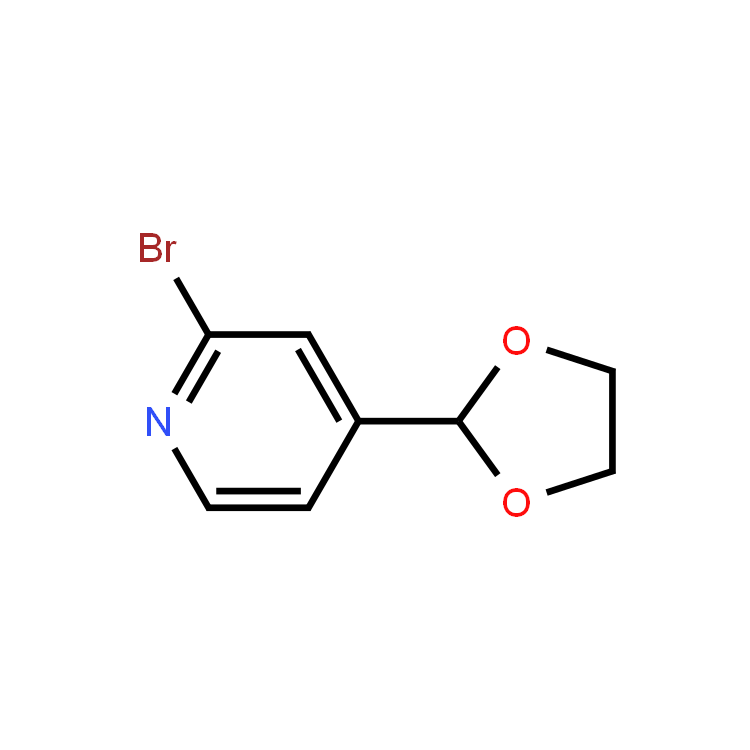
2-BROMO-4-(1,3-DIOXOLAN-2-YL)PYRIDINE、118289-18-2
AI Product Description
*The following content is generated by AI and is for reference only.
2-Bromo-4-(1,3-dioxolan-2-yl)pyridine is a specialized organic intermediate widely utilized in the fields of medicinal chemistry and agrochemical research. With the CAS Registry Number 100589-76-6, this compound features a pyridine core substituted with a bromine atom at the second position and a 1,3-dioxolane protecting group at the fourth position. Its molecular formula is C8H8BrNO2, corresponding to a molar mass of approximately 230.06 g/mol. The presence of the dioxolane moiety serves as a crucial masked aldehyde functionality, offering synthetic versatility while providing stability against various reaction conditions that might otherwise affect a free aldehyde group.
The primary application of this molecule lies in its role as a building block for complex heterocyclic synthesis. In pharmaceutical development, it is frequently employed in cross-coupling reactions, such as Suzuki-Miyaura or Buchwald-Hartwig couplings, where the bromine atom acts as a reactive site for introducing diverse aryl or alkyl fragments. This allows chemists to rapidly construct libraries of pyridine-based derivatives, which are often found in active pharmaceutical ingredients (APIs) targeting oncology, infectious diseases, and neurological disorders. Furthermore, the compound is valuable in agrochemical manufacturing, contributing to the synthesis of novel pesticides and herbicides designed to enhance crop protection and yield.
From a safety perspective, handling this substance requires standard laboratory precautions due to the potential reactivity of the halogenated pyridine structure and the sensitivity of the acetal group to acidic hydrolysis. It should be stored in a cool, dry place away from strong acids and oxidizing agents to maintain integrity. While specific toxicity data may vary based on impurities, general guidelines suggest treating it as a potential irritant. Researchers appreciate this intermediate for its high purity and reliability in multi-step synthesis protocols, making it an essential tool for accelerating drug discovery pipelines and optimizing chemical processes in industrial settings.





 (All Rights Reserved)
![8-Oxa-1,3-diazaspiro[4.5]decane-2,4-dione](https://eimg.pharmasources.com/image/product/20250403/60fa7223d5a34f24138486ceea0ffb15jpg)
![6,8-Dioxo-5,7-diazaspiro[3.4]octane-2-carboxylic acid](https://eimg.pharmasources.com/image/product/20250403/02effeb5a7639bc84ff1f3add3c0c64fjpg)
![8,16-Diazadispiro[6.1.6.2]heptadecan-17-one](https://eimg.pharmasources.com/image/product/20250403/ca91cba8b87e53fc879f8d8764873a40jpg)