Product Description
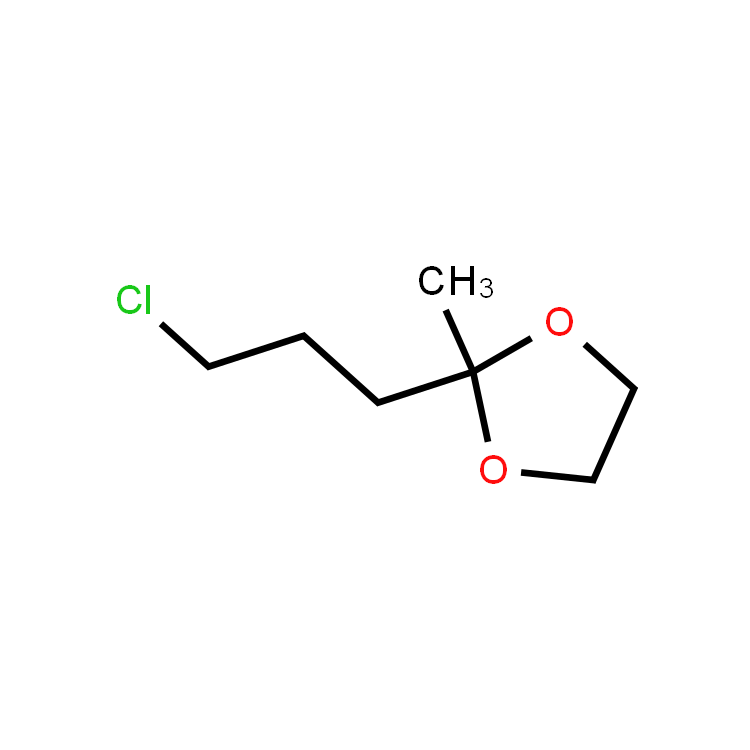
2-(3-Chloropropyl)-2-methyl-1,3-dioxolane、5978-08-5
AI Product Description
*The following content is generated by AI and is for reference only.
2-(3-Chloropropyl)-2-methyl-1,3-dioxolane is a specialized organic compound widely utilized in the fields of chemical synthesis and pharmaceutical manufacturing. With the molecular formula C7H13ClO2 and a CAS registry number of 109528-64-7, this molecule features a dioxolane ring substituted with both a methyl group and a chloropropyl chain. This specific structural arrangement imparts unique reactivity profiles, making it an invaluable intermediate for creating more complex heterocyclic systems. The presence of the chlorine atom on the propyl side chain allows for versatile nucleophilic substitution reactions, enabling chemists to introduce various functional groups efficiently.
In industrial applications, this compound serves primarily as a building block for synthesizing agrochemicals, including herbicides and fungicides, where precise stereochemistry and functional group placement are critical for biological activity. Furthermore, its utility extends into the pharmaceutical sector, where it acts as a precursor for developing active pharmaceutical ingredients (APIs) targeting specific metabolic pathways. The dioxolane moiety often functions as a protecting group strategy in multi-step synthesis, safeguarding carbonyl functionalities while other parts of the molecule undergo transformation. Once the desired synthetic steps are complete, the protecting group can be selectively removed under controlled acidic conditions to reveal the underlying aldehyde or ketone.
The physical properties of 2-(3-chloropropyl)-2-methyl-1,3-dioxolane include stability under neutral conditions but susceptibility to hydrolysis in acidic environments. It typically appears as a clear, colorless liquid with a distinct odor, soluble in common organic solvents like dichloromethane and ethanol, yet insoluble in water. Handling requires standard laboratory safety precautions due to the potential irritant nature of alkyl halides. Researchers value this reagent for its high purity and reliability in producing consistent reaction yields. As demand for advanced organic materials grows, derivatives based on this scaffold continue to play a pivotal role in innovation across fine chemical industries. Its ability to facilitate the construction of diverse molecular architectures ensures its enduring relevance in modern synthetic chemistry laboratories worldwide.











 (All Rights Reserved)
![8-Oxa-1,3-diazaspiro[4.5]decane-2,4-dione](https://eimg.pharmasources.com/image/product/20250403/60fa7223d5a34f24138486ceea0ffb15jpg)
![6,8-Dioxo-5,7-diazaspiro[3.4]octane-2-carboxylic acid](https://eimg.pharmasources.com/image/product/20250403/02effeb5a7639bc84ff1f3add3c0c64fjpg)
![8,16-Diazadispiro[6.1.6.2]heptadecan-17-one](https://eimg.pharmasources.com/image/product/20250403/ca91cba8b87e53fc879f8d8764873a40jpg)