Product Description
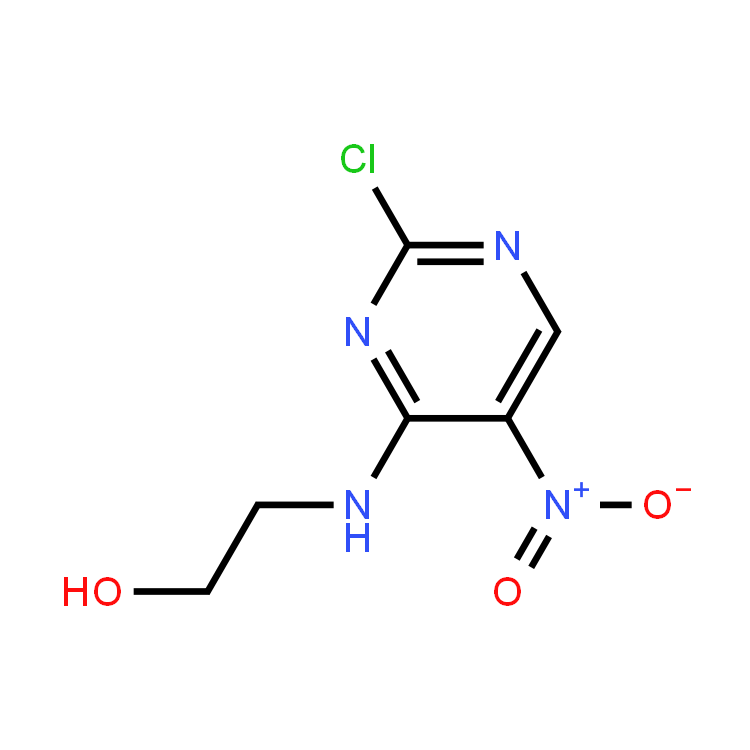
2-((2-chloro-5-nitropyrimidin-4-yl)amino)ethan-1-ol、810677-57-7
AI Product Description
*The following content is generated by AI and is for reference only.
2-((2-Chloro-5-nitropyrimidin-4-yl)amino)ethan-1-ol is a specialized organic intermediate primarily utilized in the pharmaceutical and agrochemical industries for the synthesis of complex heterocyclic compounds. With the molecular formula C6H7ClN4O3, this compound features a pyrimidine core substituted with a nitro group at the 5-position, a chlorine atom at the 2-position, and an amino-ethanol side chain attached at the 4-position. While specific CAS registry numbers for this exact derivative may vary depending on commercial cataloging or recent database updates, it generally falls under the classification of functionalized nitro-pyrimidines used as building blocks in medicinal chemistry.
The primary utility of this molecule lies in its role as a precursor for bioactive agents. The presence of the reactive chloro substituent allows for nucleophilic substitution reactions, facilitating the attachment of various amine groups to create diverse analogs. Simultaneously, the nitro group serves as a versatile handle for reduction to amines, enabling the construction of amino-pyrimidine derivatives which are common scaffolds in kinase inhibitors and antimicrobial drugs. The hydroxyethylamino tail provides additional points for further derivatization, allowing chemists to tune the lipophilicity, solubility, and binding affinity of the final drug candidates.
In research settings, this compound is frequently employed in fragment-based drug discovery programs to explore structure-activity relationships (SAR) within the pyrimidine series. Its stability under standard laboratory conditions makes it suitable for multi-step synthetic sequences involving protection-deprotection strategies. Although not typically found as a finished consumer product, it represents a critical link in the supply chain for developing novel therapeutics targeting oncology, infectious diseases, and inflammatory disorders. Manufacturers often supply this material in high purity grades to ensure reproducibility in clinical trial materials. Due to the presence of the nitro group, handling requires adherence to safety protocols regarding potential explosive hazards when dry or exposed to shock, although it is generally stable in solution. As the demand for targeted therapies grows, intermediates like 2-((2-chloro-5-nitropyrimidin-4-yl)amino)ethan-1-ol remain essential tools for chemical biologists and process chemists aiming to accelerate the development of next-generation small molecules.











 (All Rights Reserved)
![8-Oxa-1,3-diazaspiro[4.5]decane-2,4-dione](https://eimg.pharmasources.com/image/product/20250403/60fa7223d5a34f24138486ceea0ffb15jpg)
![6,8-Dioxo-5,7-diazaspiro[3.4]octane-2-carboxylic acid](https://eimg.pharmasources.com/image/product/20250403/02effeb5a7639bc84ff1f3add3c0c64fjpg)
![8,16-Diazadispiro[6.1.6.2]heptadecan-17-one](https://eimg.pharmasources.com/image/product/20250403/ca91cba8b87e53fc879f8d8764873a40jpg)