Product Description
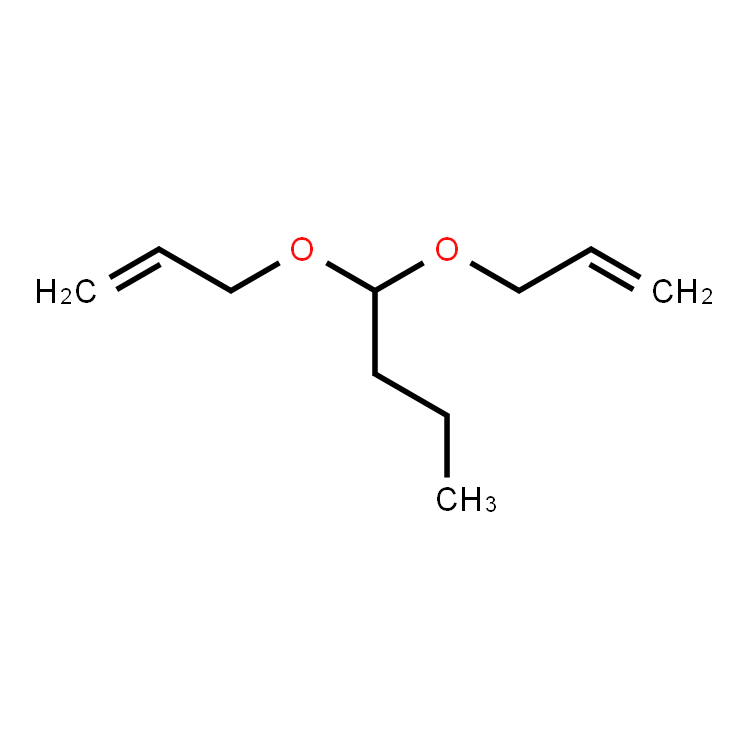
1,1-Bis(prop-2-enoxy)butane、35020-94-1
AI Product Description
*The following content is generated by AI and is for reference only.
1,1-Bis(prop-2-enoxy)butane is a specialized organic compound belonging to the class of bis-acrylate monomers. Its chemical structure features a central butane backbone substituted at the 1-position with two prop-2-enyloxy groups, creating a molecule capable of forming cross-linked networks upon polymerization. The molecular formula for this substance is C10H16O2, and it is uniquely identified by the CAS Registry Number 5439-78-7. This specific acetal derivative serves as a crucial intermediate in advanced materials science, particularly within the field of photopolymerizable resins.
The primary application of 1,1-Bis(prop-2-enoxy)butane lies in the formulation of high-performance coatings, adhesives, and printing inks. Due to the presence of two reactive vinyl groups on each molecule, it functions effectively as a multifunctional cross-linking agent. When exposed to ultraviolet (UV) light or heat in the presence of a suitable photoinitiator, the double bonds undergo rapid free-radical polymerization. This process transforms the liquid monomer into a dense, three-dimensional thermoset network, significantly enhancing mechanical strength, chemical resistance, and thermal stability of the final cured material.
In industrial settings, this compound is valued for its ability to reduce shrinkage during curing compared to some mono-functional acrylates, thereby improving dimensional accuracy in precision molding applications. It is frequently utilized in the production of optical lenses, electronic encapsulants, and protective surface finishes where durability and clarity are paramount. Furthermore, its unique structure allows for tailored rheological properties, making it adaptable to various coating formulations ranging from thin films to thick structural layers. While handling requires standard safety precautions due to potential skin irritation and sensitization associated with acrylates, its performance benefits make it an indispensable component in modern manufacturing processes. Researchers continue to explore its derivatives for next-generation smart materials and sustainable polymer systems, highlighting its ongoing relevance in chemical engineering and materials development.





 (All Rights Reserved)
![8-Oxa-1,3-diazaspiro[4.5]decane-2,4-dione](https://eimg.pharmasources.com/image/product/20250403/60fa7223d5a34f24138486ceea0ffb15jpg)
![6,8-Dioxo-5,7-diazaspiro[3.4]octane-2-carboxylic acid](https://eimg.pharmasources.com/image/product/20250403/02effeb5a7639bc84ff1f3add3c0c64fjpg)
![8,16-Diazadispiro[6.1.6.2]heptadecan-17-one](https://eimg.pharmasources.com/image/product/20250403/ca91cba8b87e53fc879f8d8764873a40jpg)