purity >98.5%
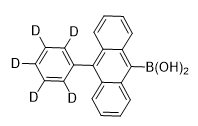
D ratio>98%
powder,
Cas: 1453199-87-5
the iintermediate can be used in pharmaceutical synthesis and Oled materials synthesis.
We researched & produced oled more than ten years. We provide simiilar OLED structure customization.
*The following content is generated by AI and is for reference only.
(10-(Phenyl-d5)anthracen-9-yl)boronic acid is a specialized organoboron compound designed primarily for advanced materials research and high-performance organic synthesis. Chemically, it features an anthracene core substituted at the 9-position with a boronic acid group and at the 10-position with a deuterated phenyl ring (C6D5). The molecular formula is C20H11BD4O2B, reflecting the incorporation of four deuterium atoms which replace hydrogen in the terminal phenyl moiety. Its specific CAS number is 1387636-47-8, distinguishing it from non-deuterated analogs. This isotopically labeled reagent is a critical tool in the development of organic light-emitting diodes (OLEDs), where precise control over emission properties and stability is paramount. The presence of deuterium enhances the thermal and photochemical stability of the resulting materials by strengthening carbon-deuterium bonds compared to their carbon-hydrogen counterparts, thereby reducing degradation rates under operational stress. Furthermore, this compound serves as an essential building block in Suzuki-Miyaura cross-coupling reactions, allowing chemists to synthesize complex conjugated polymers and small molecules with defined isotopic signatures. These signatures are invaluable for mechanistic studies, enabling researchers to track reaction pathways and kinetic isotope effects with high precision using techniques such as mass spectrometry or nuclear magnetic resonance spectroscopy. In the pharmaceutical sector, deuterated variants are increasingly explored to modulate metabolic profiles, potentially extending the half-life of drug candidates. The synthesis of this material typically involves the lithiation of 10-bromoanthracene followed by reaction with deuterated phenyl bromide or similar precursors, culminating in borylation. Due to its sensitivity to moisture and air, handling requires inert atmosphere conditions to maintain purity. As demand grows for next-generation optoelectronic devices and stable therapeutic agents, (10-(phenyl-d5)anthracen-9-yl)boronic acid stands out as a versatile precursor facilitating the creation of robust, high-efficiency functional materials.





 (All Rights Reserved)
![(6-phenyldibenzo[b,d]thiophen-4-yl)boronic acid](https://eimg.pharmasources.com/image/20250918/VzkRtcz9igDw870AqZ3zYo3SOO3IOeqwh9VdEbLS.png)

![[1,1':4',1''-Terphenyl]-2,6-diol, 2'-fluoro-](https://eimg.pharmasources.com/image/20240314/BTJGUNOZ2gmyX3HLfV4HO89Qpi7WQfGsPD1Qh3Az.jpeg)
![Diethyl-2-acetamido-2-(7-chloro-5-(2-fluorophenyl)-3H- benzo[e][1,4]diazepin-2-yl)malonate](https://eimg.pharmasources.com/image/20240603/kCK1tVKXvO7mdpLTBNii5x61NUulXBiqHBf6clcn.png)