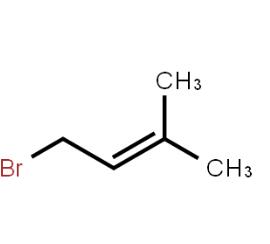
Chinese name 1-bromo-3-methyl-2-butene
English name 1-Bromo-3-methyl-2-butene
Chinese alias: bromoisopentene; 3,3-dimethylallyl bromide; 4-bromo-2-methane-2-butane; 4-bromo-2-methane-2-butene; 4-bromo- 2-methyl-2-butene;1-bromo-3-methylbutene;1-bromo-3-methane-2-butene;1-bromo-3-methylbutene
CAS RN 870-63-3
EINECS No. 212-799-5
Molecular formula C5H9Br
Molecular weight 149.029
Used as a pesticide and pharmaceutical intermediate
*The following content is generated by AI and is for reference only.
1-Bromo-3-methyl-2-butene is a specialized organic halide widely recognized in the pharmaceutical and fine chemical industries for its role as a versatile synthetic intermediate. With the molecular formula C5H9Br and a CAS number of 764-08-1, this compound features a branched carbon skeleton containing a terminal double bond and a bromine atom attached to an allylic position. This specific structural arrangement imparts high reactivity, making it particularly valuable for nucleophilic substitution and elimination reactions. The allylic nature of the bromine allows for facile displacement by various nucleophiles under mild conditions, facilitating the construction of complex molecular architectures.
In research and development settings, 1-Bromo-3-methyl-2-butene serves as a crucial building block for synthesizing heterocyclic compounds, including pyridines and pyrroles, which are fundamental scaffolds in drug discovery. It is frequently employed in cross-coupling reactions, such as Suzuki-Miyaura or Heck couplings, to introduce diverse functional groups onto the carbon backbone. Furthermore, its utility extends to the preparation of agrochemicals, where the methyl-substituted butenyl moiety contributes to biological activity profiles. Due to its volatility and potential toxicity, handling requires strict adherence to safety protocols, including the use of fume hoods and appropriate personal protective equipment.
The compound is typically supplied as a clear, colorless to pale yellow liquid with a characteristic pungent odor. Its physical properties, including a boiling point around 105°C, allow for easy purification via distillation when high purity is required for sensitive catalytic processes. While not commonly found in consumer products, its industrial significance lies in enabling the efficient synthesis of active pharmaceutical ingredients (APIs) and advanced materials. Researchers value its cost-effectiveness relative to more complex precursors, offering a streamlined pathway to generate structurally diverse derivatives. As demand grows for novel therapeutics and functional polymers, the application scope of this allylic bromide continues to expand within the global chemical supply chain.





 (All Rights Reserved)
![Pyrrolo[2,3-d]pyrimidin-4-ol](https://eimg.pharmasources.com/image/20250423/cvXgKDastRYgD63GYBroAOcjpuRzGHJvGxhaKgvA.gif)
![4-Chloro-7H-pyrrolo[2,3-d]pyrimidine](https://eimg.pharmasources.com/image/20250423/Vo6dULaYnbLZCd7lJ7013faOnpM4iolBbJyR708d.gif)
![1,6-dihydro-5-hydroxy-1-methyl-2-[1-methyl-1-[[(phenylmethoxy)carbonyl]amino]ethyl]-6-oxo-4-Pyrimidi](https://eimg.pharmasources.com/image/20240312/35lb1ifZuXM3CbTyv7zwyPrhcXy4bmyDTBeUKkDN.gif)