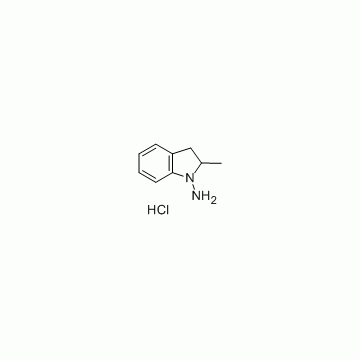
Product name: 1-Amino-2-methylindoline hydrochloride
Synonyms: 1-AMINO-2-METHYLINDOLINE;1-AMINO-2-METHYL INDOLINE HCL;1-AMINO-2-METHYLINDOLINE HYDROCHLORIDE;2,3-Dihydro-2-methyl-1H-indol-1-amine hydrochloride;N-AMINO-2-METHYLINDOLINE;N-amino-2-methylindoline hydrochloride;2-Methylindolin-1-AmineHydrochloride;IndapaMide Related CoMpound B
CAS No.: 102789-79-7
Molecular formula: C9H13ClN2
Molecular weight: 184.67
EINECS No.: 1806241-263-5
Application: IndapaMide’s intermediate
*The following content is generated by AI and is for reference only.
1-Amino-2-methylindoline hydrochloride is a specialized organic intermediate widely utilized in the pharmaceutical and agrochemical industries for the synthesis of complex heterocyclic compounds. With the Chemical Abstracts Service (CAS) Registry Number 136948-07-5, this compound serves as a critical building block in medicinal chemistry research. Its molecular formula is C9H13ClN2, reflecting its structure as a protonated derivative of 1-amino-2-methylindoline, where the hydrochloride salt form ensures enhanced stability and solubility compared to the free base. The molecule features an indoline core substituted with a methyl group at the second position and an amino group at the first position, providing versatile reactive sites for various chemical transformations such as acylation, alkylation, or condensation reactions.
In practical applications, 1-Amino-2-methylindoline hydrochloride is frequently employed in the development of novel drug candidates targeting central nervous system disorders, cardiovascular conditions, and inflammatory diseases. The presence of the indoline scaffold is particularly valuable due to its structural similarity to bioactive alkaloids found in nature, often conferring high binding affinity to specific biological receptors. Researchers utilize this reagent to construct diverse libraries of indole-based derivatives, which are essential for high-throughput screening assays aimed at identifying potential therapeutic agents. Furthermore, its role extends into the synthesis of advanced materials and dyes, although pharmaceutical applications remain predominant.
The hydrochloride salt format offers significant advantages during laboratory handling, including improved resistance to oxidation and easier purification processes. This stability allows chemists to store the material under standard conditions without rapid degradation, facilitating long-term synthesis projects. While primarily a research-grade chemical, strict adherence to safety protocols is mandatory when handling this substance, as it may exhibit irritant properties upon contact with skin or eyes. As global demand for innovative small-molecule drugs continues to rise, intermediates like 1-Amino-2-methylindoline hydrochloride remain indispensable tools for accelerating the drug discovery pipeline from initial concept to clinical candidate.





 (All Rights Reserved)
![Pyrrolo[2,3-d]pyrimidin-4-ol](https://eimg.pharmasources.com/image/20250423/cvXgKDastRYgD63GYBroAOcjpuRzGHJvGxhaKgvA.gif)
![4-Chloro-7H-pyrrolo[2,3-d]pyrimidine](https://eimg.pharmasources.com/image/20250423/Vo6dULaYnbLZCd7lJ7013faOnpM4iolBbJyR708d.gif)
![1,6-dihydro-5-hydroxy-1-methyl-2-[1-methyl-1-[[(phenylmethoxy)carbonyl]amino]ethyl]-6-oxo-4-Pyrimidi](https://eimg.pharmasources.com/image/20240312/35lb1ifZuXM3CbTyv7zwyPrhcXy4bmyDTBeUKkDN.gif)

![Diethyl-2-acetamido-2-(7-chloro-5-(2-fluorophenyl)-3H- benzo[e][1,4]diazepin-2-yl)malonate](https://eimg.pharmasources.com/image/20240603/kCK1tVKXvO7mdpLTBNii5x61NUulXBiqHBf6clcn.png)
