
Last week, Eli Lilly posted its Q2 and H1 financial reports this year. With the sales volume of Tirzepatide of USD 1.548 billion in H1 of the year and other excellent performances higher than expected, Eli Lilly's stock price rose by 14.87% on that day. As one of the transnational pharmaceutical companies, Eli Lilly's market value was once over USD 500 billion, occupying the hot search page at that time. Until now, almost all top ten transnational pharmaceutical companies in the world have published their semi-annual reports.
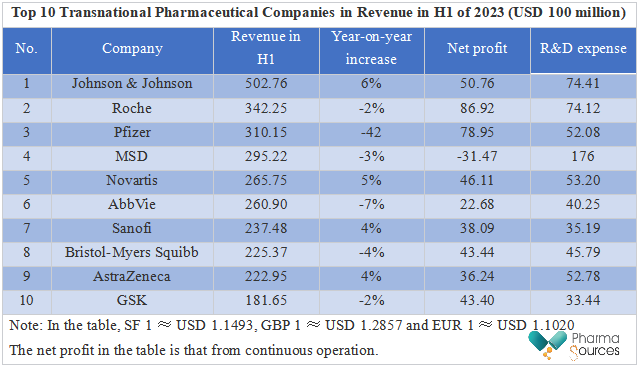
Table: Top 10 Transnational Pharmaceutical Companies in Revenue in H1 of 2023 (USD 100 million)
From the semi-annual report data of transnational pharmaceutical companies, it can be seen that in the past half year, some companies had good achievements while others were confronted with difficulties. Depending on anti-COVID-19 oral medicine, Paxlovid, and COVID-19 vaccine, Comirnaty, Pfizer earned a lot of money in the previous two years, but it suffered a sharp drop in revenue in H1 of this year. Eli Lilly and Novo Nordisk became big winners with the blessing of their diet pills. According to data released by pharmaceutical companies, many projects have been cut off just in H1 of the year, valuing billions of dollars, which shows that, in the global pharmaceutical capital winter, even transnational pharmaceutical companies must allocate resources rationally and make every penny count.
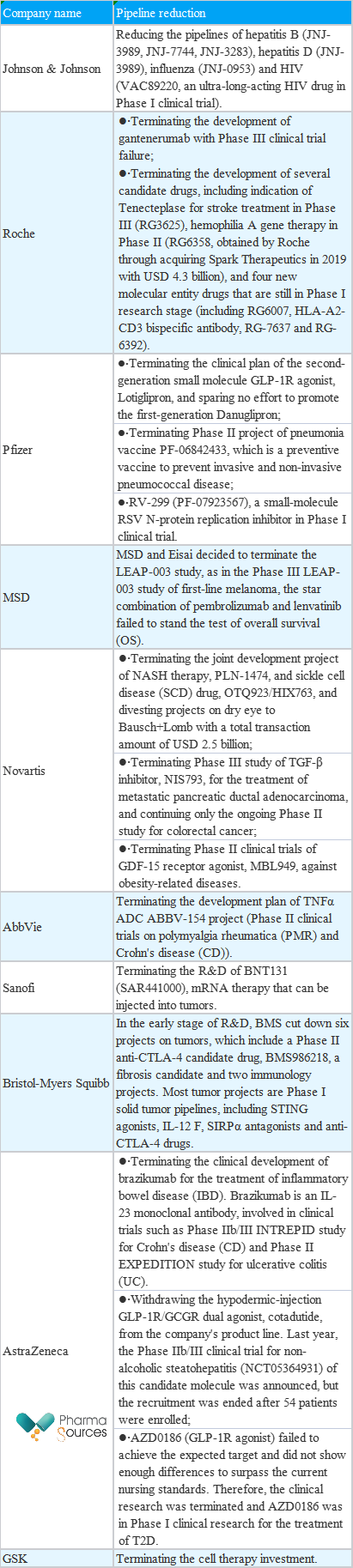
Table 2 Pipeline Reduction of Transnational Pharmaceutical Companies in H1 of 2023 (According to Incomplete Statistics in Financial Reports and Public Information)
01 Whole Line Reduction
Reducing pipelines is actually not rare, especially for transnational pharmaceutical companies. There are usually dozens or even more than 100 clinical projects, especially preclinical projects, in their pipelines. It is also common to reduce one or two or even more in the R&D process. In fact, because of the huge and even slightly redundant operating system of transnational pharmaceutical companies, reducing pipelines can be more beneficial for them to integrate resources, achieve differentiated layout and take the lead. Therefore, it must be a kind of strategy to decide which one to reduce and how to conduct.
It is the most decisive to give up the whole research. At the beginning of this year, GSK directly announced that it would terminate its R&D investment in cell and gene therapy, including a letetresgene-autoleucel (lete-cel) in Phase III and GSK3845097 (NY-ESO1/dnTGFb TCR-T) and GSK39019611 (NY-ESO-1/CD8a TCR-T) in Phase I. Company executives said that although cell therapies such as CAR-T had significant success in treating hematologic tumors, there were too many projects in this field, and the prospect of expanding to the field of solid tumors was far more challenging than supposed. Therefore, given all the development and manufacturing costs and possible risks, it is not the best option for GSK to continue to invest in the cell therapy.



























 (All Rights Reserved)