
Recently, the United States Pharmacopeia (USP) published a report that brings to light a concerning reality: approximately 85% of active pharmaceutical ingredients (APIs) used in brand-name prescription drugs in the United States are imported. The timing of this revelation is particularly notable, as it coincides with the Trump administration's proposed tariff policy on pharmaceuticals - an alert to the global pharmaceutical industry.
1. "Foreign Ancestry" of United States Medicines
According to the report, only 15% of APIs used in branded drugs of the United States are manufactured domestically. The majority come from abroad, with Europe accounting for 43%, India 2%, and China 3% (Figure 1). This heavy reliance on foreign sources suggests that the proposed tariff measures could bring significant challenges to pharmaceutical companies, including soaring costs and constrained supply chains.
Under the Trade Agreements Act, the country of origin for pharmaceuticals is typically determined by the source of APIs, unless the product undergoes "substantial transformation" in another country. As a result, even if the finished dose form is manufactured and packaged in the United States, it may still be classified as a "foreign product" subject to tariffs if its APIs are sourced from abroad.
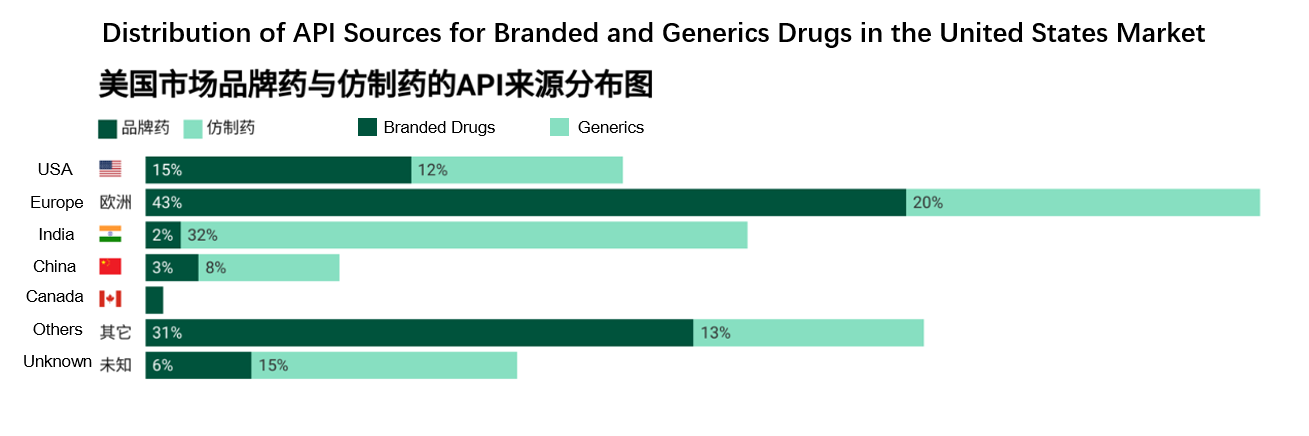
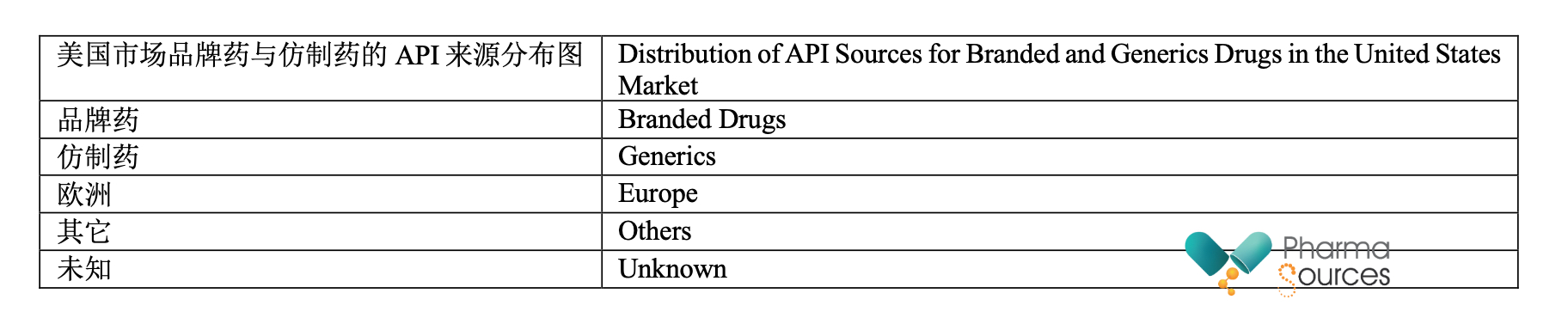
Figure 1. Composition of API Sources for Branded Drugs and Generics in the United States Market. (Source: United States Pharmacopeia)
2. European API Industry: The Biggest Potential Casualty of United States Tariffs?
Europe has long held a prominent position in global API production, renowned for its high quality standards and technological sophistication. It remains a key player, particularly in the fields of high-end small molecule APIs and complex chemical synthesis. Countries such as Germany, Switzerland, and Italy host world-class GMP manufacturing bases, and have been long-standing suppliers of critical raw materials to major branded pharmaceutical companies of the United States.
According to data from the USP report, 43% of the APIs used in branded drugs of the United States are sourced from Europe. In contrast, India and China contribute just 2% and 3%, respectively, to the API supply for branded drugs. This heavy reliance on European sources makes API enterprises in Europe the most vulnerable if tariff policies are implemented. As Marta Wosińska, a prominent health economist and former FDA official, bluntly stated, "Europe has far more API manufacturing plants than the United States - if tariffs are imposed, they will clearly be hit the hardest."
3. Pharmaceutical Companies of Generics are Not Immune - How Will India and China Respond?
While the API supply for branded drugs is largely dominated by the United States and Europe, the generics market tells a different story - its API supply is heavily reliant on India and China (Figure 1).
· India accounts for 35% of United States generics API imports, leveraging a significant cost advantage in the off-patent drug field.
· China accounts for 8%. Although its share is relatively small, it holds a dominant position global...

























 (All Rights Reserved)