

Pharmaceutical companies are exploring means to faster the steps in pharmaceutical development i.e. to go from the pre-clinical phase to clinical trials as efficiently as possible. In terms of efficient lab operation and R&D workflows biotech companies are implementing following in trend ways to speed up the drug development process in their pipeline. The clinical trial industry is evolving at a rate that is difficult for pharmaceutical corporations to stay up with.[1]
NLP Text Mining Automation
The massive amounts of data they handle and the steady stream of new knowledge they learn are impeding their old procedures. There is a solution provided by automation. Automation can increase trial efficiency, improve patient recruitment, and speed up data analysis by optimizing workflows,
decreasing manual chores, and eliminating human error. The long-term advantages of automation outweigh the time and effort required to deploy it. It has the potential to accelerate medication development by freeing up funds for fresh initiatives. Most common in use is target identification and
validation using AI-powered literature mining, such algorithms are able to quickly scan through a large body of scientific literature to find possible drug targets. Using high-throughput computer techniques, in silico screening can find potential candidates by digitally screening millions of chemicals against target proteins. Businesses in the bio sciences are using natural language processing (NLP)to go from molecules to markets.[2] For example, Pfizer's capacity to monitor rival activities and pinpoint possible therapeutic targets has been greatly enhanced by their patent search service driven by NPL. Pfizer was able to decrease human labor, improve data comprehensiveness, and speed up the discovery of new insights by automating the process of extracting important information from patent filings. Across the enterprise, this solution has shown to be a useful resource for researchers and decision-makers.[2]
Other than that, through the extraction of important data from preclinical safety reports, Merck's NLP process offers researchers a thorough understanding of pertinent information. Merck can lower the possibility of late-stage failures and more accurately evaluate the applicability of preclinical data to human safety by looking at the interpreted outcomes sections. With the aid of this technology, Merck has been able to make better selections and increase the general effectiveness of their drug development procedure.[2] Eli Lilly use NLP to examine the connections between publication volume
and the effectiveness of medication development. Likewise companies are using NLP for developing the robust pipeline for indications with the evidence based real world data.[3]
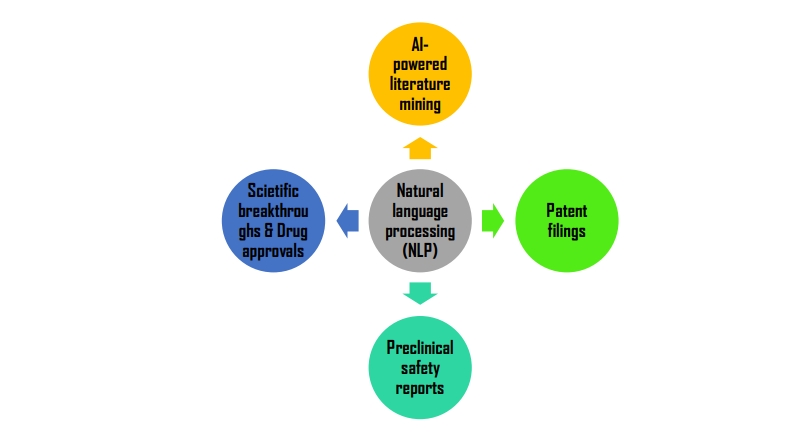
Figure 1. AI based Natural language processing (NLP) text mining is executed for drug development process while screening patent filling, preclinical safety report, liteature to scientifc breaktrough and drug approvals Improving trials through digital health technologies (DHTs)
Improving trials through digital health technologies (DHTs)
Patient trial experiences can be greatly improved by digital health technology. Pharmaceutical firms may enhance patient recruitment, participation, and overall happiness by using these technologies from the outset of their studies. Software for remote collaboration can help expedite lab staff procedures by guaranteeing prompt access to patient data and avoiding delays. The use of digital health technologies (DHTs) in medication development has a lot of potential advantages. DHTs can improve clinical studies by gathering real-time data from patients and providing more accurate and thorough information. The FDA has created a framework to direct the use of DHTs in medication development and is dedicated to promoting their usage. Workshops, demonstration projects, and the release of guidelines are all part of this framework. For stakeholders looking for information about D...




























 (All Rights Reserved)