

By Tim Freeman, Managing Director, Freeman Technology
In a series of editorials I’m looking at variables that can impact powder behaviour. Having started by examining the effect of various properties of particles (please take a look at the other articles in this series – ‘Exploring the Impact of Particle Shape on Bulk Powder Properties’ and ‘Exploring the Impact of Particle Size on Bulk Powder Properties’), I’m now turning to a system variable - humidity. Moisture can significantly influence powder behaviour, especially flow properties and quantifying its effect is essential in order to develop effective control strategies for a specific application. There can be significant cost involved in removing water from the atmosphere in a processing environment, or indeed from within the powder itself, and this must be balanced with maintaining acceptable processing performance. The challenge is to understand a powder’s appetite for moisture uptake and, more importantly, how moisture will affect its characteristics and performance.
The mechanisms of powder flow
For a powder to flow, the particles within it must move relative to one another. It is widely believed that introducing water makes powders flow less freely, and there are mechanistic reasons to support this concept. Water in a powder often forms liquid bridges between particles that would otherwise be subject to relatively low interparticulate forces. Wet granulation exploits this mechanism, but when it occurs in routine operation such bridging can inhibit the movement of the particles, with a detrimental impact on performance.
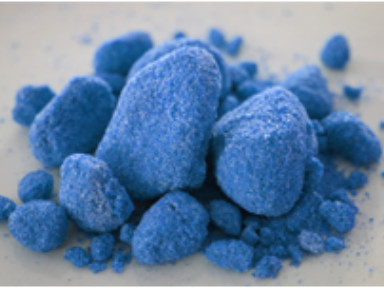
Figure 1 - Liquid bridging
Conversely, there are times when moisture improves flow behaviour. In the case of particles with a rough surface, for example, low levels of moisture can act as a lubricant, allowing the powder to flow more freely. Water can also improve the performance of electrostatically charged powder by improving its electrical conductivity. Dissipating electrostatic charge in this way can reduce the strength of interparticulate cohesive forces with a dramatic impact on flow behaviour, especially for powders with relatively small particle size.
Since moisture can induce these very different effects, it is vital to accurately measure its influence. We’ve recently conducted research in this area and have found dynamic powder testing, alongside bulk property measurement, to be particularly informative.
Measuring the impact of humidity
Dynamic powder testing involves measuring the axial and rotational forces acting on a blade as it rotates through a powder sample, to determine flow energies. Basic Flowability Energy (BFE) is the flow energy measured as the blade passes down through a powder sample of uniform, low to moderate packing density. However, one of the benefits of dynamic measurement is that it can be applied to consolidated, conditioned (as in the case of BFE), aerated, and even fluidised powders to assess how powders will behave in different processing environments.
The graphs below show how BFE, Aerated Energy and permeability change as a function of moisture content for microcrystalline cellulose (MCC) [PH200, FMC]. These data were generated using an FT4 Powder RheometerTM, with Aerated Energy measured with air flowing up through the sample at a low velocity (2mm/s) to minimize moisture loss.
Dynamic and permeability data sensitively describe the impact of humidity on MCC and support an understanding of the mechanisms defining flow behaviour in this system.
The results show interesting and perhaps unexpected behaviour, with both BFE and Aerated Energy passing through a minimum as moisture content increases from the initially desiccated condition. During the study it was observed that the sample had a tendency to coat the test vessel, suggesting that it may be electrostatically charged. This points to a rationale for the observed behaviour, where at low moisture levels the water increases electrical conductivity, reducing interpar...


























 (All Rights Reserved)