

Experiment Administration and Data Collecection
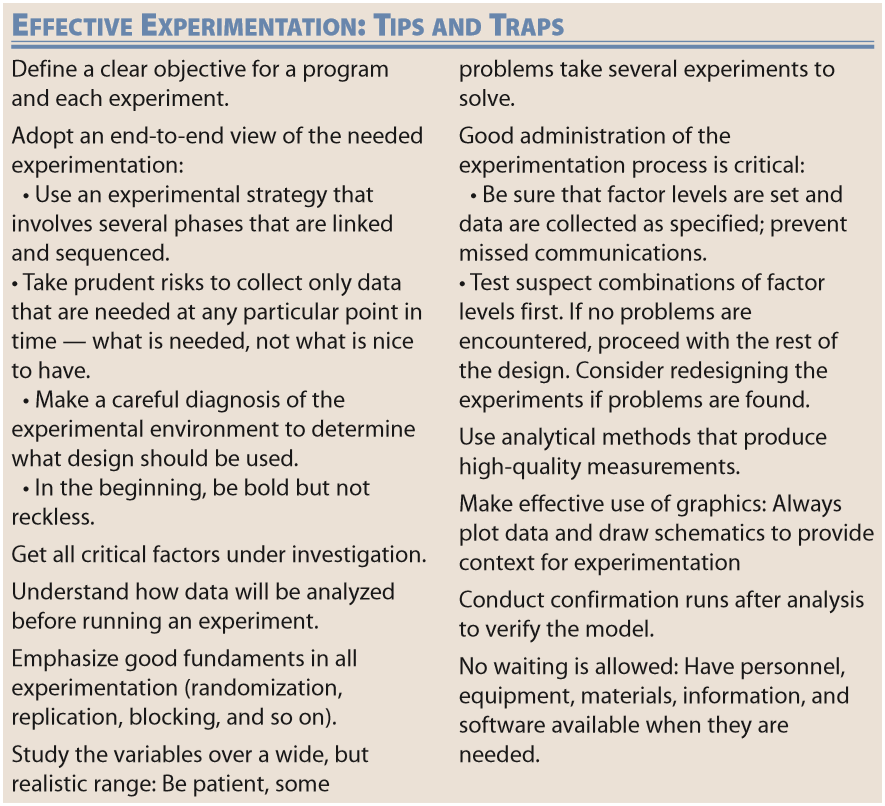
Administration of an experimental program is a vital step that is often overlooked. It must be carefully planned and executed. As John Wooden, arguably the most successful college basketball coach ever, has admonished us, “Failing to plan is planning to fail.”
The first aspect of planning is to make sure that you have all the personnel, equipment, and materials needed to construct the experimental program. There should be no waiting around, which can be a big source of waste in R&D laboratories.
An experiment should be randomized and conducted in the randomized order. If randomization isn’t done or runs are derandomized to make an experimental work more convenient, then a critical aspect of experimentation is ignored.
Another important issue is finding out during testing that experimental combinations couldn’t be completed. To help prevent this, evaluate all runs in a design for operability. If some are suspect, then make those runs first to see whether they can be done. If not, consider changing their levels (e.g., move the run closer to the center of the design) or changing the range of critical variables and recreating the design. Several options will become clear in each situation. The critical point is to consider the situation up front and plan for how to deal with an eventuality should it occur.
Data Analysis and Modedel Building
Many points could be made here; I will address a few. First you need a process for conducting analysis such as that shown in the “Method for Building Process and Product Models” box (14). This roadmap gives you a plan to follow and points out key events that must happen.
Next, you need to make effective use of graphics, a best practice for using statistical thinking and methods. Graphics work because of humans’ ability to see patterns in data that are too complex to be detected by statistical models.
When a poor fit of a model is obtained (a low adjusted R2 value), it can be a result of several factors, including an important variable missing from the model, the wrong model being used (e.g., a linear model used when the response function is curved), and atypical values in the data (outliers). These issues are fairly well known. Poor measurement quality can be a source of poor fit of a model to the data. Your model may be correct and the fit have a low adjusted R2 value as a result of high measurement variation introduced by a poor measurement system.
Residual analysis is another aspect of good statistical practice. A residual is the difference between the observed measurement and the value predicted by the model Y = f(X). Residual analysis provides much information (e.g., the presence of missing variables, outliers, and atypical values; and a need for curvature terms in a model).
Confirmation Studieses
A fundamental of good experimental practice is completing confirmation experiments. This documents that the results and recommendation of your experiments can be duplicated and that the model you developed for the system accurately predicts response behavior. Confirmation experiments are best conducted in an environment where results will be used such as the manufacturing process instead of a laboratory.
Findings, Conclusions, and Rececommendations
It is good practice to make oral presentations of findings and recommendations before writing a report (14). Present first to a small group of stakeholders to assess reaction and receptivity to your results, then present to broader audiences. You can improve your presentation using input you receive from various groups. Afterward, you are in a position to write a report (that will probably go unnoticed because your results will already be accepted and thus be old news).
Presentation and written reports should contain graphics summarizing and communicating important findings. Graphs might include histograms, dot plots, main effects, two-factor interactions, and cube plots. A good graphic is understood by both presenter and user and is simple and easy to understand. There is elegance in simplicity.
Be careful when reproducing ...

























 (All Rights Reserved)