
Recently, the heat on ADC pipeline deals is around, and the deal sizes are kept refreshing.
On February 23, Keymed Biosciences Inc. announced that KYM Biosciences, a joint venture established by Keymed (70% of KYM ownership) and Lepu Biopharma, and AstraZeneca have entered into a global exclusive out-license agreement to develop and commercialize CMG901. CMG901 is a Claudin 18.2-targeting anti-body drug conjugate (ADC) comprising of a Claudin 18.2-specific antibody, a cleavable linker and a toxic payload, monomethyl auristatin E (MMAE), which is co-developed by Keymed Biosciences Inc. and Lepu Biopharma. Under the terms of the agreement, AstraZeneca will be granted an exclusive global license for research, development, registration, manufacturing, and commercialization of CMG901; In return, KYM Biosciences shall receive an upfront payment of US$ 63 million with the potential for additional payments up to US$ 1.125 billion subject to achievement of certain development, regulatory and commercial milestones.
On February 26, it is reported that Pfizer is in talks to acquire Seagen, a pioneer in ADC, in a potential deal that is likely valued more than US$ 30 billion. In July last year, rumor had it that MSD was in talks to acquire Seagen in a deal that could be worth roughly US$ 40 billion or more, however, finally it was reported that the two companies couldn't reach an agreement over pricing.
Two deals got leaked out in four days, ADC is getting hot again. Currently, a total of 15 antibody-drug conjugates (ADCs) are currently approved for marketing globally. The global ADCs market size was valued at US$ 5.221 billion in 2021. And the annual average compound growth rate was about 30% from 2014 to 2021. As a result, the race contract development and manufacturing organizations (CDMOs) for ADCs is rising.
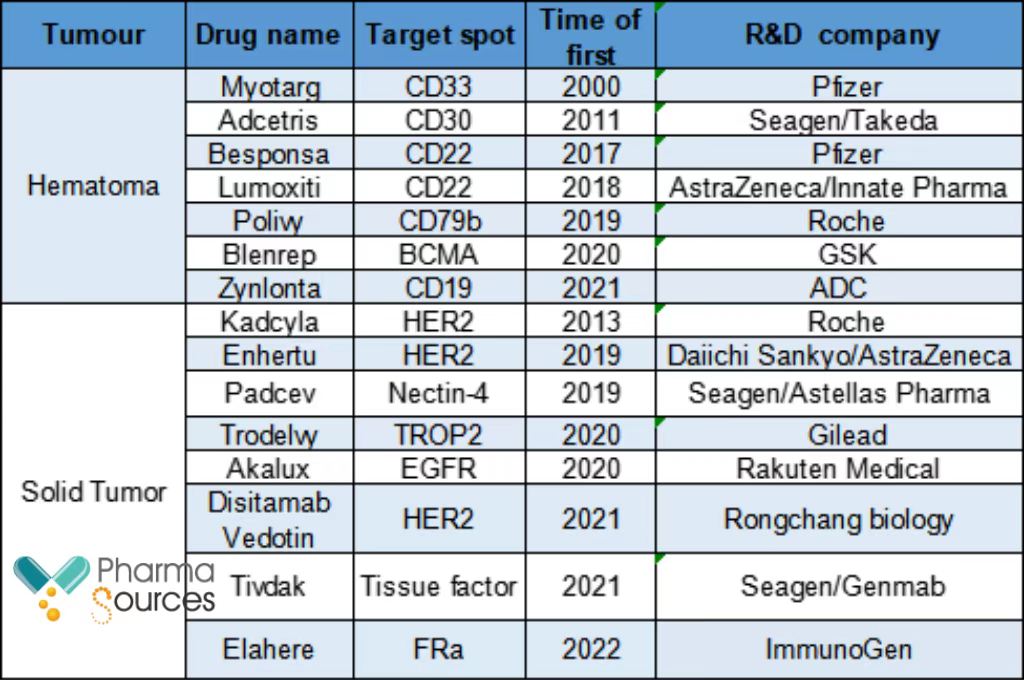
Approved ADC for marketing globally
(Sources: IQVIA Research, CITIC Securities, released information)
Why projects of ADC are in favor of outsourcing?
ADC (Antibody-Drug Conjugate) has three main components: the antibody, the linker, and the payload. Wherein, the antibody is a monoclonal antibody drug with strong target specificity that can accurately target tumor cells; the payload is a small molecular toxin with high toxicity that strengthens tumor cell killing capability of ADC; the linker is a chain-typed molecular tool for connecting the other two functional molecules used in the synthesis of ADC.
An ideal ADC shall remain stable in blood circulation, reach the therapeutic target accurately and eventually release the cytotoxic payloads in the vicinity of the targets (e.g., cancer cells) to have killing effects on tumor cells.
The projects of ADC not only require the manufacturing enterprise to master the development and manufacturing of the monoclonal antibody and the bioconjugate, but also can develop the linker and the payload, which have very high manufacturing challenges. Thus, many developers of ADC choose to outsource operations. According to the data released in last September from MSD's ADC base, 70% of current ADC projects under development were outsourced to professional outsourcing agencies.
Daiichi Sankyo made it clear that it will spend US$ 13.6 billion on ADC and bispecific antibody technology under its five-year plan, among which US$ 2.3 billion will be spent on the supply chain, and a large amount of expense will be paid to the CDMO.
Therefore, the broad market prospects, booming R&D enthusiasm and relatively high outsourcing rate all provide CDMO with great development opportunities. But CDMO itself doesn't have the ability to solve the "one stop" manufacturing of ADC, many mergers and combinations emerge.
ADC CDMO powerful combination
- Read More
























 (All Rights Reserved)