
Recently, cepharanthine, first discovered in China as the new drug for treating COVID-19, has recently been granted the national invention patent authorization, which has drawn great attention from inside and outside the industry. In accordance with the authorized invention patent, "10uM cepharanthine can inhibit the replication of coronavirus by 15,393 times", and it's firmly remarkable and exciting for inhibition effect on coronavirus. Let's take a look at the following synthesis technology of this natural product.
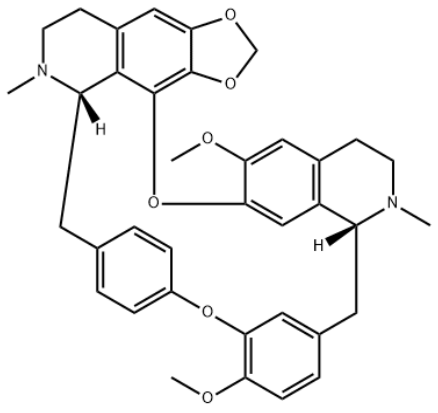
Figure 1 Structural formula of Cepharanthine
There is only one report on the synthesis technology of cepharanthine via retrieval, which is applied to synthesize the racemate of cepharanthine. As shown in Figure 2, the first one is to synthesize the intermediate 5. Aldehyde 1 is utilized as the starting material in this process, which reacts with dibromomethane to obtain intermediate 2. With the catalysis of ammonium acetate, intermediate 2 reacts with nitromethane to form intermediate 3. The intermediate 3 is reduced under the reduction conditions of Clemmensen to obtain amine compound 4. The intermediate 5 can be obtained by aldehyde reaction of compound 4.
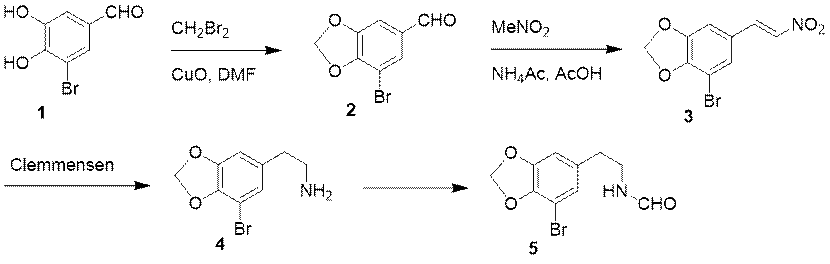
Figure 2 Synthesis of Intermediate 5
The researchers explored the synthesis of intermediate 9. Compound 6, as raw material, reacts with ethyl chloroformate to obtain intermediate 7. The intermediate 7 is reduced under the reduction conditions of Clemmensen to obtain amine compound 8. The amino group of compound 8 is under the protection of Cbz to obtain intermediate 9.
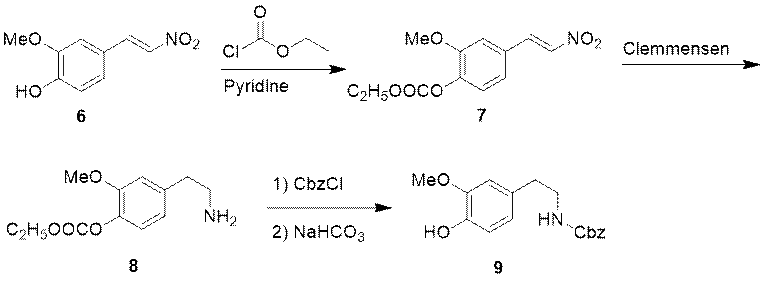
Figure 3 Synthesis of Intermediate 9
Next, the researchers made intermediate 5 to react with intermediate 9. With the methods of Ullmann condensation and the removal of the aldehyde group, the intermediate 10 can be obtained.
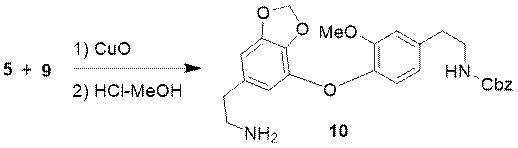
Figure 4 Synthesis of Intermediate 10
The intermediate 13, taking carboxylic acid 11 as the raw materials, can be synthesized by removing benzyl protection of intermediate 12, which can be obtained by esterification.

Figure 5 Synthesis of Intermediate 13
The intermediate 16 is synthesized with compound 14 as the raw materials, which firstly undergoes the methylation reaction with dimethyl sulfate under the catalysis of the potassium carbonate to obtain intermediate 15. After the Ullmann condensation reaction of intermediate 13 and 15, the intermediate 16 is obtained under the hydrolyzation of p-Toluenesulfonic acid.


























 (All Rights Reserved)