
With the release of semi-annual reports of pharmaceutical companies in succession, the top 10 best-selling drugs in the world in H1 of 2023 have been unveiled. Among them, Dupixent (Dupilumab), a drug star product in the autoimmunity field of Sanofi/Regeneron, ranked sixth with sales volume of EUR 4.878 billion (around USD 5.35 billion), a year-on-year increase of 36.7% (CER). There is no suspense that it will exceed USD 10 billion at the end of the year, showing a super bombshell style.
As a fully humanized monoclonal antibody, Dupixent can restrain the signal transduction of IL-4 and IL-13 pathway, targeting at patients with type-2 inflammation. Dupixent was first approved in 2017 for the treatment of atopic dermatitis, followed by approvals for indications including asthma, chronic rhinosinusitis with nasal polyps, prurigo nodularis and eosinophilic esophagitis.
In China, Dupixent received approval for the treatment of moderate and severe atopic dermatitis in adults in June 2020. At the end of December 2020, Dupixent was officially listed in the National Catalog of Medicines for Basic Medical Insurance, Work-Related Injury Insurance, and Maternity Insurance (2020 Edition) through the national medical insurance negotiation. In September 2021, Dupixent was approved in China for the treatment of moderate and severe atopic dermatitis in adolescents aged 12 and above and adults who are in poor control or not recommended with external drugs. In February 2022, Dupixent received NMPA approval for the treatment of moderate and severe atopic dermatitis in children aged 6 and above and adults who are in poor control or not recommended with external drugs.
Under the influence of Dupixent, there is a R&D boom of IL-4 targets in China.
Target of key inflammation: IL-4
The immune system acts as a natural barrier of the human body. In the human immune system, after stimulation, primitive T cells can differentiate into helper T cells (Th) which have different pathways, and different forms of inflammation responses can be divided based on the cytokine groups secreted by Th cells. In which, Th2-mediated type-2 inflammation has been shown to play a main role in the barrier immunity on the mucosal surface. Th2 mainly works by secreting cytokines IL-4, IL-5, IL-9 and IL-13. IL-4 is a key cytokine, which can induce primitive CD4 + T cells to differentiate into Th2 cells, which can in turn generate more cytokines and cause type-2 inflammation response.
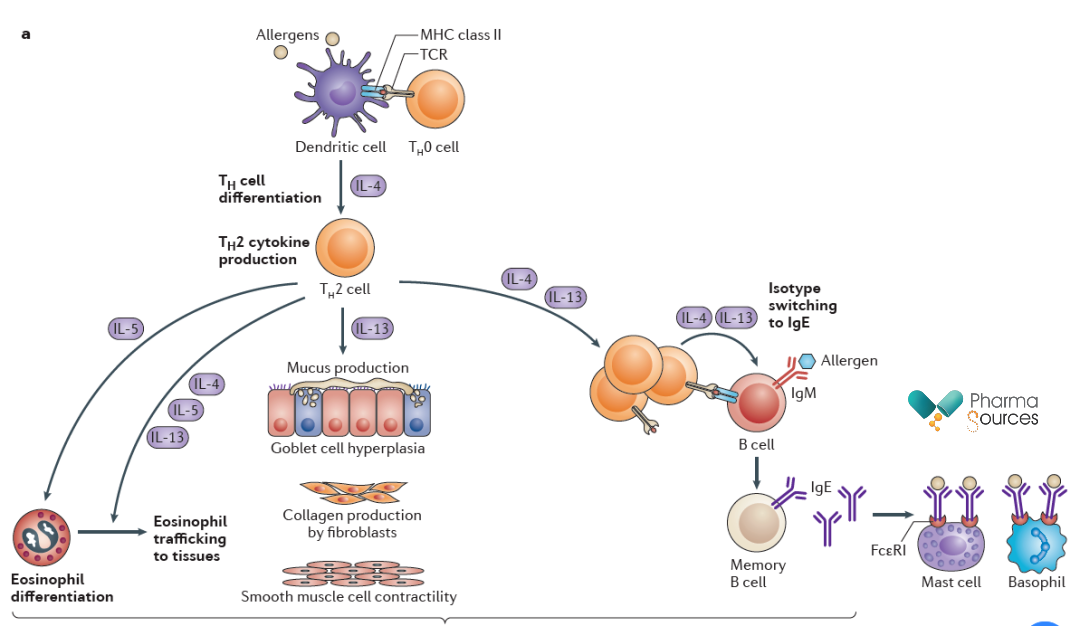
Mechanism of Action of IL-4 in Type-2 Inflammation (Source: Reference 1)
Studies have shown that IL-4 exerts biological activity by binding to its specific receptor (IL-4R). There are two types of IL-4R. Type 1 receptor, which can specifically bind to IL-4, consists of IL-4Rα subunit and γc subunit, and it is usually located on the surface of T cells, B cells, eosinophils, etc. Type 2 receptor, which can bind to IL-4 and IL-13 simultaneously, consists of IL-4Rα subunit and IL-13Rα1 subunit, and it is mostly located in epithelial cells, smooth muscle cells, etc. The binding of IL-4 to the extracellular domain of IL-4Rα brings about the conformational change of the intracellular receptor domain, activating the receptor-related Janus kinase and resulting in the recruitment and phosphorylation of STAT6. Activated STAT6 forms a homodimer, forming the translocation to the cell nucleus and facilitating the transcription of genes responsive to IL-4. Other phosphorylated tyrosine residues bind to proteins possessing the structural domain of phosphotyrosine binding (PTB), including insulin receptor substrate (IRS) proteins. The phosphorylated IRS proteins can activate PI3K/AKT signaling pathway or MAPK cascade reaction, thus activating a series of biologic...


![(2S,5S)-5-[2-[(2S,4R,6R)-6-[[(2S,3S,4R,5R)-5-[(2S)-2,3-Bis[[(1,1-dimethylethyl)dimethylsilyl]oxy]pro](https://eimg.pharmasources.com/image/product/20211111/7713ac8fb10bcab819a66c24fb7544bcjpg)
























 (All Rights Reserved)