
According to the 2019 results and company progress released by Zai Lab on Mar. 19, the total sales revenue of niraparib (trade name: Zejula) reached USD6.60 million (around RMB46.90 million) in Hong Kong, S.A.R., China and Macau, S.A.R., China region of China in 2019. Niraparib has been approved in Dec. 2019 in Mainland China and its sales revenue is expected to largely increase in 2020.
As a highly potent and selective poly (ADP-ribose) polymerase (PARP)-1/2 inhibitor, niraparib can bind to PARP and inhibit the dissociation of PARP from DNA-PARP compound to block subsequent DNA repair and play the anti-tumor role.
R&D process of niraparib:
- Zai Lab reached a strategic cooperation agreement with TESARO in Sep. 2016 to obtain the exclusive R&D and marketing rights of niraparib in the Chinese market, and TESARO reserves the option to participate in the cooperative marketing of niraparib in China;
- The drug was first approved in the U.S. in Mar. 2017 and in Europe in November of the same year for the maintenance treatment of patients with recurrent epithelial ovarian, fallopian tube, or primary peritoneal cancer who are in a complete or partial response to platinum-based chemotherapy;
- The drug was successively approved for marketing in Hong Kong, S.A.R., China and Macau, S.A.R., China Region of China in Oct. 2018 and June 2019;
- The drug was approved by the NMPA for marketing in Mainland China in Dec. 2019 for the maintenance treatment of adult patients with recurrent epithelial ovarian, fallopian tube, or primary peritoneal cancer who are in a complete or partial response to platinum-based chemotherapy;
- The marketing application for a new indication of niraparib has been officially accepted by the CDE in Mar. 2020, which is the maintenance treatment of adult patients with advanced epithelial ovarian, fallopian tube, or primary peritoneal cancer who are in a complete or partial response to the first-line platinum-based chemotherapy.
Excellent clinical effects
The large-scale Phase 3 ENGOT-OV16/NOVA Clinical Trial was conducted for niraparib and recruited both patients with BRCA mutations and patients without BRCA mutations.
Clinical trial design: 553 patients with recurrent epithelial ovarian, fallopian tube, or primary peritoneal cancer who were in response to platinum-based treatment were recruited, including 203 with BRCA mutations and 350 without BRCA mutations; they separately received niraparib or placebo treatment according to the ratio of 2:1, with the starting dose of niraparib being 300mg/day.
According to the clinical data:
In patients with gBRCA (germline BRCA) mutations: The median progression-free survival (PFS) of patients in the niraparib group reached up to 21 months, while that of patients in the placebo group reached 5.5 months, meaning that the maintenance treatment with niraparib could reduce the disease progression or death risk by 73%;
In patients without gBRCA mutations but whose tumors tested positive for homologous recombination deficiency (HRD): The median PFS of patients in the niraparib group reached 12.9 months, while that of patients in the placebo group reached 3.8 months, meaning that the maintenance treatment with niraparib could reduce the disease progression or death risk by 55%;
In patients without gBRCA mutations and whose tumors tested negative for HRD: The median PFS of patients in the niraparib group reached 9.3 months, while that of patients in the placebo group reached 3.9 months. See the following figure for the details:
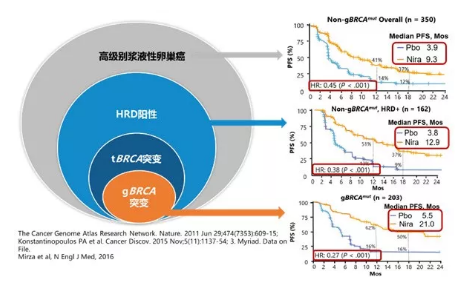
高级别浆液性卵巢瘤 | High grade serous ovarian cancer |
HRD阳性 | HRD positive |
tBRCA突变 | tBRCA mutation |
gBRCA突变 | gBRCA mutation |
We can see from the above c...






























 (All Rights Reserved)