
Recently, Amplia Therapeutics Limited announced its FAK inhibitor AMP945 under research combined with FOLFIRINOX was effective on the preclinical model of pancreatic cancer; Mice treated with AMP945 and FOLFIRINOX have a higher survival rate than those treated with FOLFIRINOX only.
AMP945, an oral focal adhesion kinase (FAK) inhibitor with a high selectivity, has been awarded the Orphan Drug Designation for pancreatic cancer and idiopathic pulmonary fibrosis by FDA. At present, AMP945 is in a Phase 1b/2a clinical trial, aiming to confirm whether it can improve the first-line therapeutic effect on patients with unresectable or metastatic pancreatic cancer to administer AMP94 before the gemcitabine and albumin paclitaxel.
About FAK
FAK, that is, focal adhesion kinase, is a kind of non-receptor protein tyrosine kinase in the cytoplasm and a kind of adaptor protein mainly regulating adhesion signaling and cell migration, which can promote cell cycle, adhesion, metastasis and survival through kinase dependence and independence.
FAK is composed of N-terminal 4.1-Ezrin-Radixin-Moesin (FERM) structural domain, central kinase domain, and C-terminal FAT structural domain with 2 PRs (PR1 and PR2) and focal adhesion localization area. Among them, the central kinase domain plays an enzyme catalytic role. N-terminal FERM structural domain mediates the direct interaction between FAK and proteins such as integrin and growth factor receptor, and binds with central kinase domain directly to prevent the substrate from binding to the catalytic domain and protect FAK from phosphorylation of sarcoma protein kinase (Src). C-terminal FAT structural domain contains a variety of protein-protein interaction binding sites, guiding FAK to focal adhesion complexes in various cells.
FAK is activated by tyrosine kinase (RTK), intracellular pH change (H+), integrin, G protein-coupled receptor (GPCR) and cytokine receptor, and increases cell motility by affecting the signaling mediated by ARP2/3, RHOGEF, talin or cortactin, and SRC or PI3K.
Studies have found that FAK can overexpressed in many tumors, such as ovarian cancer, breast cancer, lung cancer, colorectal cancer, pancreatic cancer, prostate cancer and head and neck cancer, and it is related to the poor prognosis of many cancers. It can inhibit the proliferation, migration and invasion of tumor cells to inhibit and degrade FAK. However, researchers have found that to inhibit FAK signaling pathway can effectively reverse many failed chemotherapies and targeted therapies caused by tumor drug resistance, and can enhance the response and efficacy of immunotherapy for solid tumors.
But the R&D of FAK inhibitor is not successful. Although FAK inhibitor shows certain anti-tumor activity in some tumor types, single-drug has no obvious improvement in disease treatment in the research of various companies. Thus, enterprises that participated in the development of FAK inhibitors in the early stage chose to give up halfway, among which Pfizer transferred defactinib to Verastem, and Boehringer Ingelheim (BI) transferred IN10018 to InxMed.
With the in-depth study of FAK target and its action mechanism, there are many FAK inhibitors under research in global at present, as shown in the table below. The development of FAK inhibitor trends to drug combinations for treating many tumors. In addition to chemical drugs, FAK inhibitors under research also include FAK degradation agent, such as BI-3663 and BI-0319.
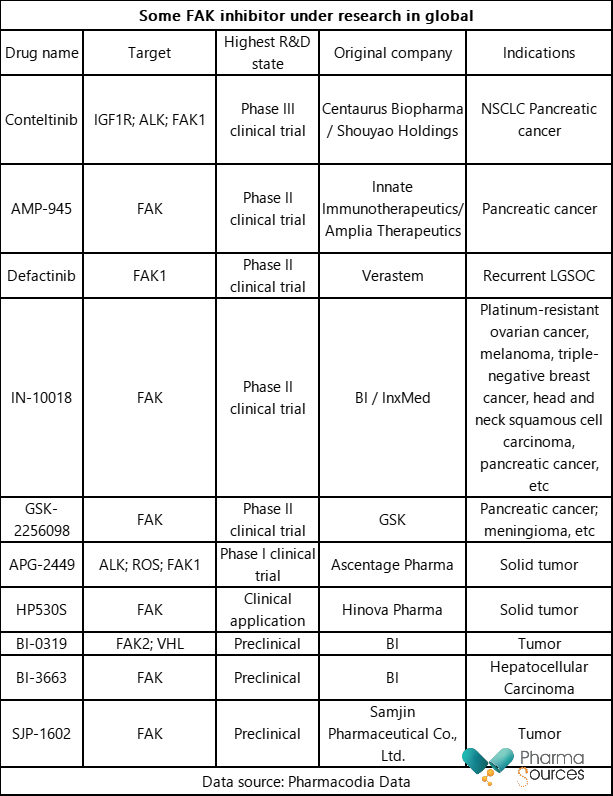
FAK inhibitors under research include some multi-target kinase inhibitors, such as Conteltinib and APG-2449. Wherein Conteltinib (CT-707) has a fast progress, and the clinical trial of its combination with crizotinib in the treatment of ALK-positive advanced NSCLC has en...


























 (All Rights Reserved)