

By Ronald D. Snee, PhD, Snee Associates, LLC
Critical Elements ofExperimental Strategies for Implementing QbD Process and product Xs and Ys: TheYs - Critical Quality Attributes (CQAs) are the critical process output measurements linked to patient needs. The Xs - CriticalProcess Parameters (CPPs) encompass theprocess input (API and excipient), control,and environmental factors that have majoreffects on the CQAs. Raw materials factorsare included as Xs.
Experiments define the data collection processes used to study the relationships between the Xs and Ys so as to identifythe critical variables. These experiments typically make use of statistical design of experiment (DOE) techniques.
Strategy of Experimentation is the process of diagnosing the experimental environmentand determining the best experimentalstrategy to satisfy the objectives ofthe experiment. Process and measurement robustness is the ability of the process and measurement system to perform when faced with uncontrolled variation in process, input,and environmental variables.
Analytical Methods plays two roles inthe approach: as the process to collect the data and as the subject of QbD studies to assure the stability, quality of the measurements,and the robustness of the measurement methods (See Schweitzer, et al 2010). Measurement system quality is a critical element of QbD that should not be overlooked.
Process Model provides a quantitative model Y=f(X) relating the product and process outputs (Ys) to the inputs (Xs). The resulting model is typically based on both fundamental and statistical relationships and is used to create the design space.
Design Space is the combination of input variables and process parameters that provide assurance of product quality.
Process and Measurement Control is the use of control procedures, including statisticalprocess control (SPC), to keep the process and measurement system on target and within the desired variation. Processand measurement capability tracks process performance relative to CQA specifications and provides measurement repeatability and reproducibility regarding CQAs.
Reduced Risk and Enhanced Complianceis a function of the design space, processand measurement capability, control, androbustness.
Central to the approach is a strategy for experimentation, summarized in Table 1(Snee 2009c). This strategy identifies three experimental environments: screening, characterization,and optimization. The objectivesof each of the three phases (desired information) are summarized in Table 1.
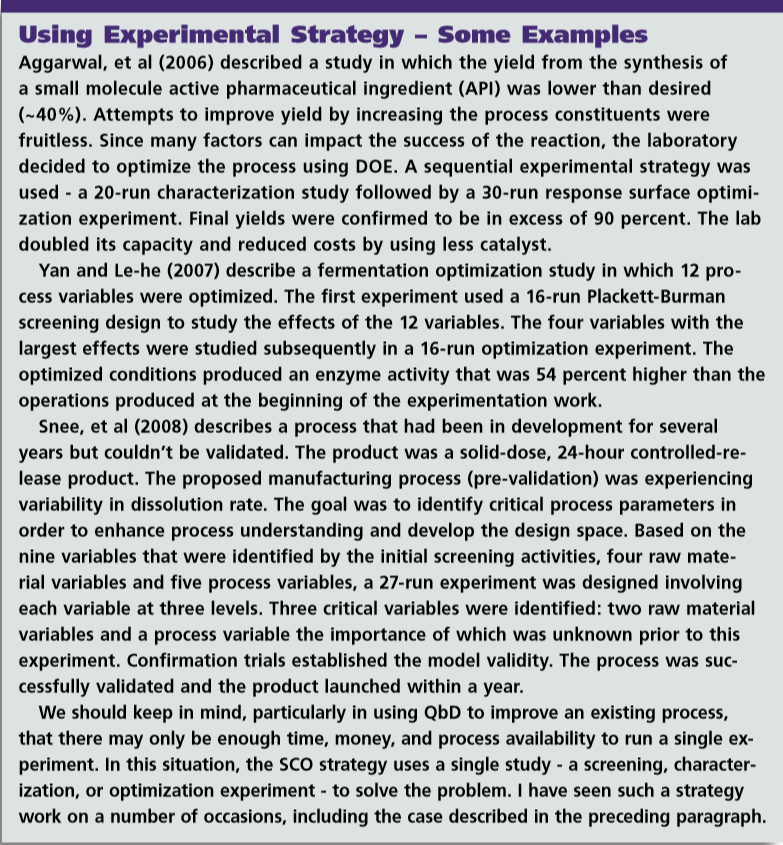
The Screening Phase explores the effects of a large number of variables with the objective of identifying a smaller number ofvariables to study further in characterization or optimization experiments. Additionalscreening experiments involving additionalfactors may be needed when the results of the initial screening experiments are not promising. On several occasions I’ve seen the screening experiment solve the problem.
When there is very little known about the system being studied, sometimes “rangefinding"experiments are used in which candidate factors are varied one at a time to get an idea of appropriate factor levels. Yes, varying one factor at a time can be useful.
The Characterization Phase helps us better understand the system by estimating interactions as well as linear (main) effects. The process model is thus expanded to quantify how the variables interact with each other as well as to measure the effects of the variables
individually.
The Optimization Phase develops a predictive model for the system that can be used to find useful operating conditions (design space)
using response surface contour plots and, perhaps, mathematical optimization.
The SCO Strategy (screening, characterization,optimization), in fact, embodies several strategies, which are subsets of the overall SCO strategy, namely:
*Screening - Characterization - Optimization.
*Screening - Optimization.
*Characterization - Optimization.
*Screening - Characterization.
*Screening.
*Characterization.
*Optimization.
The end result of each of these sequences is a completed project. There is no guarantee of success in a given instanc...



























 (All Rights Reserved)