


When working with powders, in-process performance and final product quality will be influenced by properties of the raw materials delivered to the process. The ability to control these raw materials, and therefore reliably predict process performance, is essential to ensuring the properties and quality of the final product. A method of accurately measuring process-relevant properties of incoming raw materials is therefore highly beneficial to a wide range of applications in various industries. This application note considers the evaluation of bulk excipients for tableting and the impact of storage and handling conditions.
Variations in Process Performance and Product Quality
Sorbitol was used as the bulk excipient in production of a tablet. The tablet manufacturer experienced variation in final product quality when using two batches of sorbitol that had previously been categorised as identical by the supplier. Tablets produced from one batch were consistently softer and less stable than those from the other batch. Following further investigation at the customer’s request, the excipient supplier was unable to differentiate between the batches using techniques they had available.
The only difference identified recorded about the batches was the location in which they had been stored before being supplied to the customer: the well-performing batch was stored in a silo close to the loading area (Silo 1), and the poorly-performing batch in a Silo further away (Silo 2), necessitating additional conveyance prior to processing.
Samples from both batches were analysed using an FT4 Powder Rheometer®.
Test Results
Dynamic Testing: Basic Flowability Energy
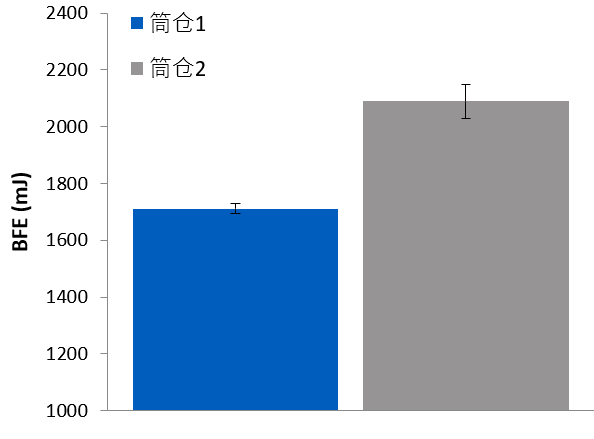
The sample from Silo 2 generated a higher Basic Flowability Energy (BFE) than the sample from Silo 1. This indicates that it was more resistant to dynamic flow in a confined space (such as in a screw conveying or mixing process) requiring more energy to achieve the same outcome.
Bulk Testing: Compressibility
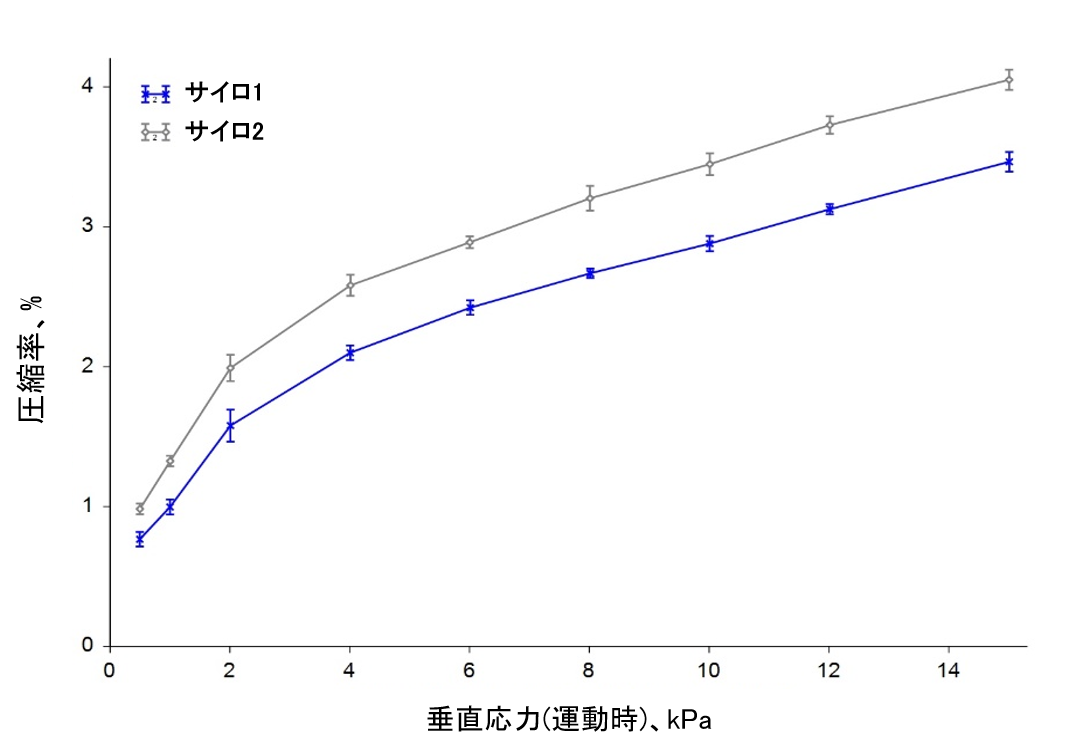
The sample from Silo 2 was more compressible than the sample from Silo 1, indicating that it entrained a greater proportion of air within its bulk, which is typically a property of more cohesive powders. Higher Compressibility can contribute to poorer behaviour in processes where a powder is subjected to an applied force, such as in mechanical feeders or tablet presses, or simply as a consequence of storage in large quantities.
Bulk Testing: Permeability
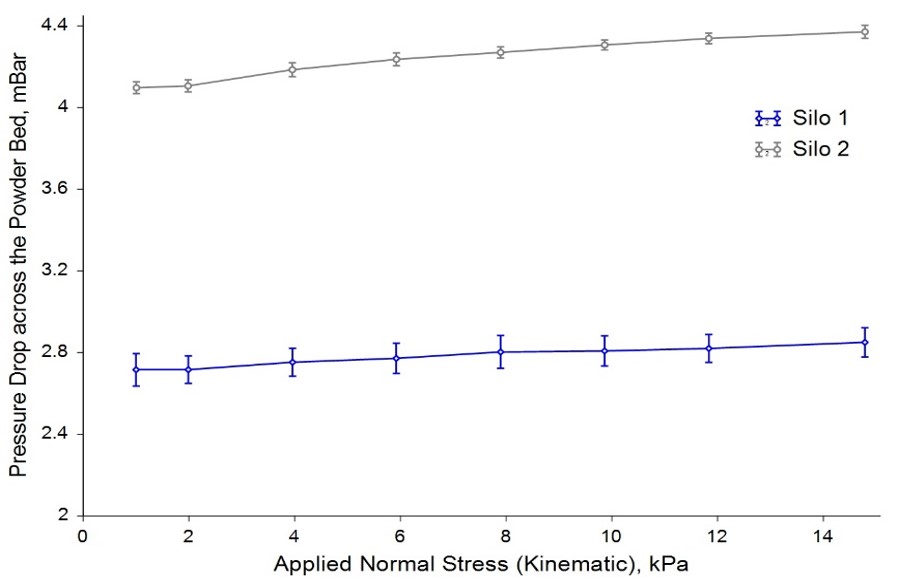
Similarly, the sample from the Silo 2 generated a higher Pressure Drop across the Powder Bed under a constant throughput of air, indicating that this sample was less permeable than the sample from the Silo 1. Low permeability can contribute to poor performance in operations where a powder is required to release entrained air, such as die filling and tableting, and can adversely impact gravitational flow in general.
Shear Cell Testing
Counter-intuitively, the sample from Silo 2 generated slightly lower Shear Stress values following consolidation at 9 kPa than the sample from Silo 1. This suggests it would more readily transition from a static, consolidated state in to a state of flow, such as when required to flow from a hopper. This illustrates how Shear Cell test results may not always be most relevant as the test conditions do not represent what the powder is subjected to in process. ...


























 (All Rights Reserved)